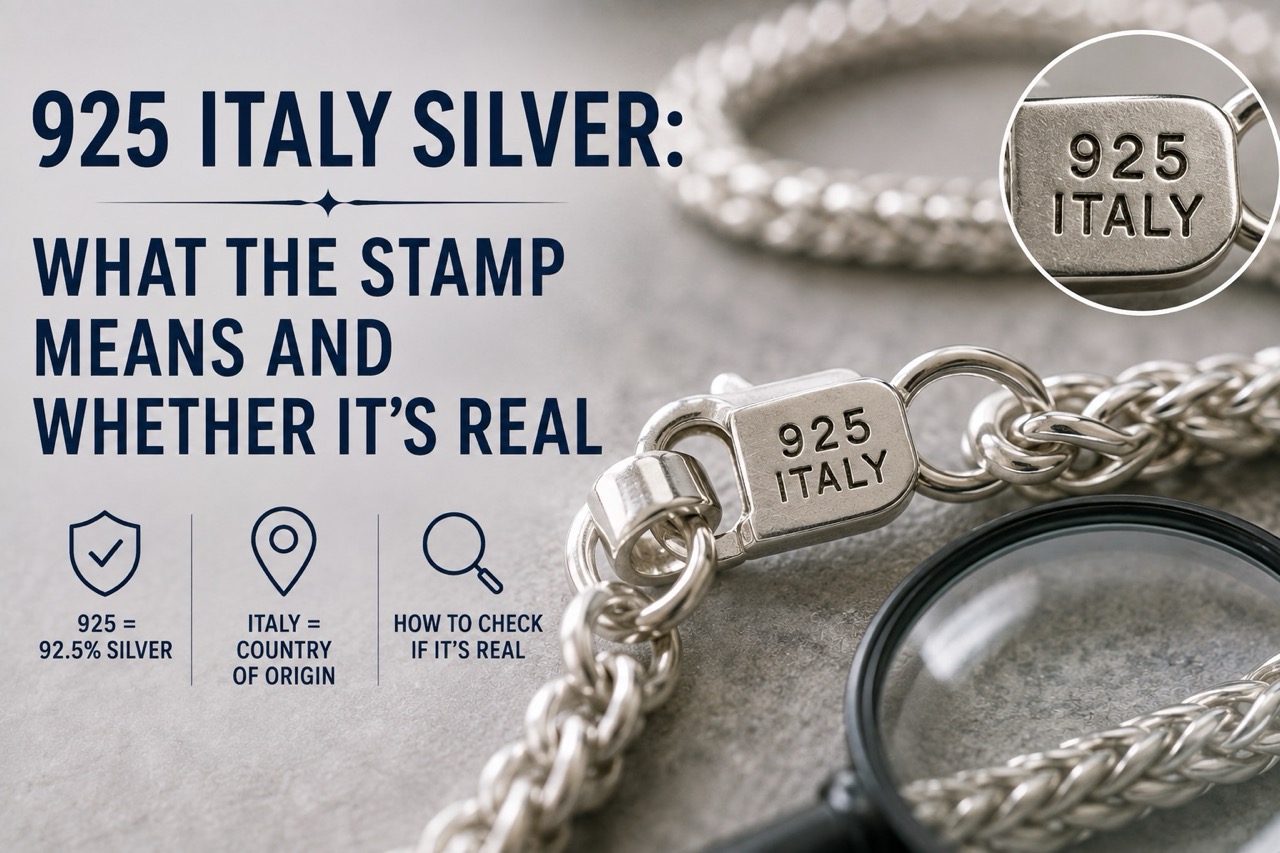
A 925 Italy stamp represents a claim that the item is 92.5% silver and Italian in origin. The 925 means 925 parts of silver per 1,000 parts of alloy, while Italy indicates the stated country of origin. It is not a separate or higher grade of sterling silver.
Italy officially recognizes 925 fineness for silver, along with 800 fineness. Modern Italian precious-metal articles can also carry an identification mark containing a star, registration number, and province abbreviation.
The stamp alone, however, does not prove that a piece is genuine. If you found 925 Italy on a chain, bracelet, ring, or necklace, you should consider the complete set of marks and the metal itself.
What Does 925 Italy Mean on Jewelry?
925 Italy combines a silver-fineness claim with a stated connection to Italy.
The number 925 expresses purity in parts per thousand:
- 925 parts silver
- 75 parts other metals
- 1,000 parts total
That equals 92.5% silver and 7.5% other metals. Copper commonly makes up much of the remaining alloy.
FTC consumer guidance likewise explains that jewelry marked 925 represents 925 parts of pure silver per thousand.
The word Italy does not increase that percentage. A genuine Italian item made from 925 silver has the same nominal silver fineness as other 925 sterling.
For more about the alloy itself, see what 925 sterling silver is.
Is 925 Italy Real Silver?
If the mark is accurate, 925 Italy jewelry is real silver containing 92.5% silver by fineness. The stamp itself cannot prove that the mark is accurate.
Anyone evaluating an unfamiliar piece should treat its markings as one piece of evidence rather than a laboratory result.
Start with several checks:
| Check | What It Can Tell You |
|---|---|
925 mark | Claims 92.5% silver fineness |
| Italian identification mark | May identify a registered producer/importer |
| Magnet response | Strong attraction raises questions about composition |
| Surface wear | Different-colored metal underneath can suggest plating |
| Professional metal test | Provides stronger evidence about composition |
The magnet test has an important limitation. Silver is not strongly magnetic, but many metals other than silver are also nonmagnetic.
A piece that does not stick to a magnet has therefore not passed an authenticity test. You have only eliminated one warning sign.
For valuable jewelry, professional metal analysis provides stronger evidence than a home magnet test.
Is 925 Italy the Same as Sterling Silver?
Yes. A 925 fineness claim corresponds to sterling silver’s 92.5% silver standard.
The FTC states that the terms “sterling” and “sterling silver” apply to products containing at least 925/1000 pure silver.
| Mark | Meaning |
|---|---|
925 | 92.5% silver fineness |
.925 | 92.5% silver fineness |
STERLING | Sterling silver |
925 Italy | 925 silver with Italian origin claimed |
800 | 80% silver fineness |
999 | 99.9% fine silver |
The Italy portion does not describe another purity level.
This means “Italian 925 silver” should not be interpreted as a metal that contains more silver than ordinary 925 sterling. Differences in price between two pieces can instead come from craftsmanship, maker, design, weight, age, condition, and retail markup.
What Does 925 Italy Mean on a Chain?
On a chain, 925 Italy still means the chain is represented as 92.5% silver and Italian in origin.
The mark commonly appears on a small component where there is enough flat space to stamp it, such as a clasp or end tag.
You may encounter variations such as:
925 ITALY
ITALY 925
.925 ITALY
The order does not change the meaning of the 925 fineness number.
Do not judge a chain’s authenticity from color alone. Genuine sterling can tarnish, while plating and other surface finishes can make silver look brighter or give it another color.
Check areas that receive frequent wear. If a silver-colored chain reveals a distinctly yellow or copper-colored metal underneath, it may be plated rather than solid sterling.
That visual clue is not conclusive on its own, but it deserves further investigation.
What Do Real Italian Silver Hallmarks Look Like?
Current Italian precious-metal marking rules provide more information than the words 925 Italy alone.
Italy’s Ministry of Enterprises and Made in Italy states that precious-metal alloys covered by the country’s rules must bear their fineness in thousandths and an identification mark. For silver, Italy recognizes 925 and 800 as legal finenesses.
The Italian identification mark consists of:
five-pointed star + registration number + two-letter province abbreviation
The registration number identifies the producer or importer in the relevant Chamber of Commerce register, while the letters identify the province associated with that registration.
A mark might therefore contain elements that look broadly like:
★ 123 AR
Here, 123 would be an identifying registration number and AR a province abbreviation. That example illustrates the format only; it is not intended to identify a particular maker.
Do not reject an older item simply because its markings differ. Italy’s precious-metal marking system has changed over time, including major legal changes in 1872, 1934, 1944, and 1968.
Use our sterling silver hallmarks guide when you need to interpret multiple symbols on the same piece.
Does 925 Italy Prove Jewelry Was Made in Italy?
No. The words indicate a claim of Italian origin, but the text alone cannot authenticate that claim.
This distinction matters with secondhand jewelry and purchases from unknown sellers.
For modern Italian precious-metal articles subject to Italy’s domestic marking system, a proper identification mark can provide more useful evidence because it links the producer or importer to a registration number and province.
The country name alone is easier to reproduce.
That does not mean a piece marked only 925 Italy is automatically fake. Age, size, applicable exemptions, export circumstances, and other factors can affect the marks found on an individual object.
Treat the complete set of marks as evidence and avoid making an authenticity decision from two words and three digits.
How Can You Tell if 925 Italy Is Fake?
Check the markings, construction, surface wear, and metal rather than relying on the 925 Italy stamp alone.
First, examine the item under magnification. Record every number, letter, symbol, and maker’s mark rather than looking only for 925.
If you find a star followed by a number and province abbreviation, that pattern is consistent with Italy’s current producer/importer identification system.
Next, inspect worn areas. Solid sterling contains silver throughout the alloy, so ordinary wear should not expose a yellow or copper-colored base-metal layer.
A magnet can provide another quick screening check. Strong attraction is inconsistent with the expected behavior of sterling itself, but lack of attraction does not prove authenticity.
For higher-value jewelry, a jeweler or precious-metals professional can perform more informative testing. X-ray fluorescence, commonly called XRF, can help identify the elements present without the same type of scratching required by traditional touchstone testing.
Professional interpretation still matters, particularly for plated or mixed-metal objects.
Is 925 Italy Silver Valuable?
Genuine 925 Italy silver has intrinsic metal value, but the stamp does not determine the item’s total resale value.
Sterling contains 92.5% silver by mass. A 20-gram sterling chain therefore contains approximately:
20 × 0.925 = 18.5 grams of silver
Since one troy ounce is approximately 31.1035 grams:
18.5 ÷ 31.1035 ≈ 0.595 troy oz
The theoretical sterling melt-value formula is:
weight in grams × 0.925 ÷ 31.1035 × silver spot price
[LIVE_PRICE_EMBED]
A buyer may offer less than theoretical melt value because refining and resale involve costs and margins.
Jewelry can also be worth substantially more than its silver content. Maker, craftsmanship, design, condition, age, and demand can create value beyond the raw metal.
Use our sterling silver calculator to estimate the silver-content value from an item’s weight.
Does 925 Italy Tarnish?
Yes. Real 925 Italy sterling silver can tarnish.
Silver reacts with sulfur-containing substances in the environment, creating silver sulfide on its surface. Sterling commonly contains copper as part of its remaining 7.5%, which can also affect surface discoloration.
Tarnish can appear yellow, brown, gray, or black depending on its thickness and surface conditions.
A darkened chain is therefore not automatically fake.
Tarnish is also different from rust. Rust refers specifically to iron corrosion. Sterling tarnishing occurs through different chemical reactions.
Cleaning can remove tarnish, but repeated aggressive polishing also removes small amounts of metal. Appropriate storage can reduce how frequently cleaning becomes necessary.
Frequently Asked Questions
Is a 925 Italy necklace real silver?
If the mark is accurate, a 925 Italy necklace contains 92.5% silver. The stamp alone cannot authenticate the metal.
Check other markings and the construction of the necklace. For a valuable piece, professional testing provides stronger evidence.
What does 925 Italy mean on a chain?
925 indicates a claimed silver fineness of 925 parts per thousand, while Italy indicates claimed Italian origin.
The phrase does not describe a special grade of Italian silver.
Is 925 Italy better than regular 925 silver?
Not in terms of silver purity. Both represent 92.5% silver.
An Italian piece can be worth more because of its maker, craftsmanship, design, or market demand, but the word Italy does not increase its silver percentage.
Is 925 Italy worth anything?
Genuine 925 silver has intrinsic precious-metal value based on its weight and the current silver price.
A desirable maker, design, or vintage piece may command more than melt value.
What does 925 Italy mean on gold-colored jewelry?
A 925 mark can appear on gold-colored jewelry if sterling silver forms the underlying metal and gold has been applied to the surface.
In the U.S., not every gold-plated sterling item qualifies as vermeil. FTC guidance requires a sterling-silver base, gold of at least 10-karat fineness, and a minimum equivalent gold thickness of 2.5 microns on significant surfaces for that description.
The Bottom Line
A 925 Italy mark represents a claim of 92.5% silver fineness and Italian origin. It does not indicate a special silver grade that is purer than other 925 sterling.
The stamp alone cannot establish authenticity. Modern Italian markings can provide stronger clues through a fineness mark plus the country’s star-number-province identification system.
If your piece has additional numbers, letters, or symbols next to 925 Italy, compare them with our sterling silver hallmarks guide before deciding what the jewelry is or what it may be worth.