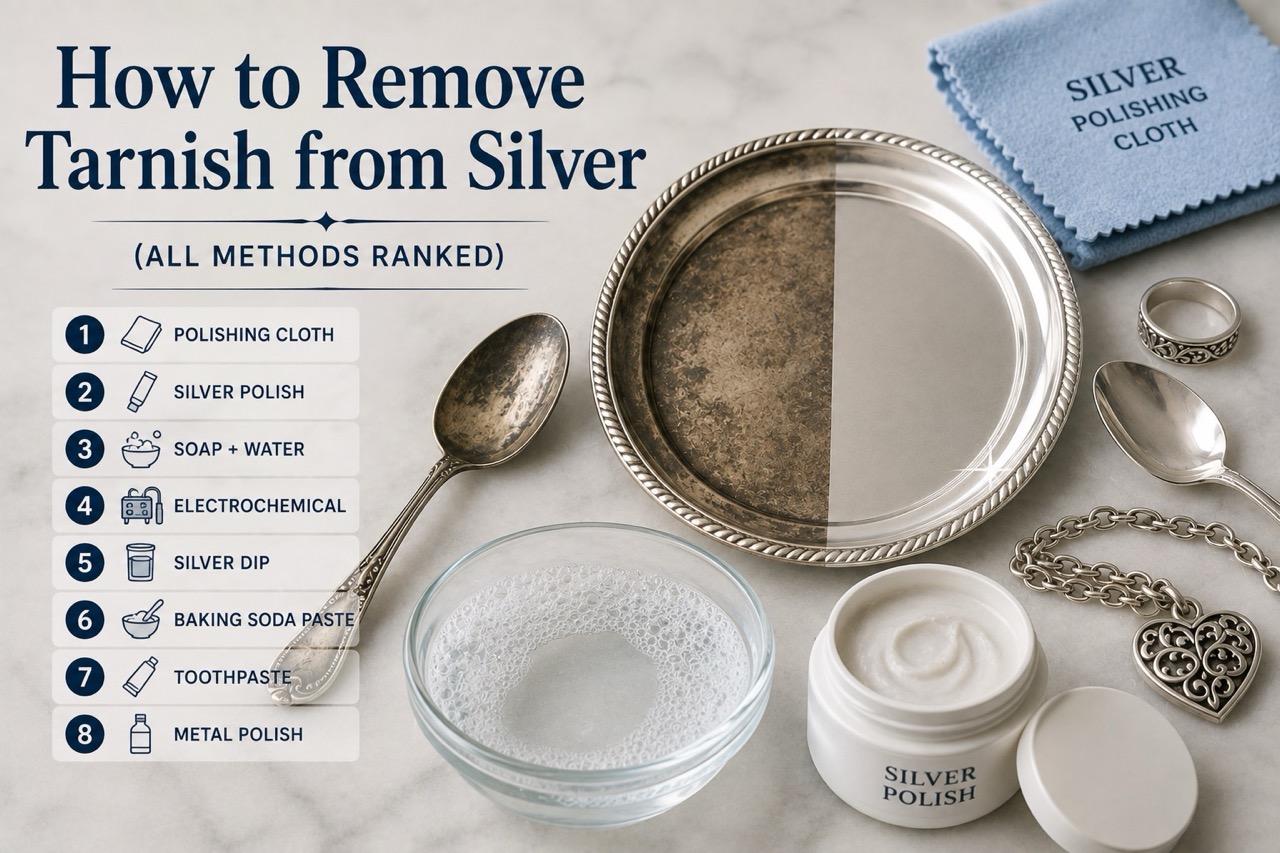
For most plain modern silver, the safest way to remove tarnish is to use the least aggressive method that achieves the appearance you want. Start by removing dirt and grease, then use a silver-polishing cloth for light tarnish or an appropriate silver polish when more tarnish removal is necessary.
Stronger methods such as chemical dips and electrochemical treatments can work, but they offer less control and are unsuitable for some objects. Every tarnish-removal method has tradeoffs.
Silver tarnish is a corrosion layer rather than ordinary dirt. Sulfur-containing gases react with silver to produce silver sulfide, which eventually gives heavily tarnished silver its dark appearance.
The rankings below prioritize surface preservation and control, not speed.
Silver Tarnish Removal Methods Ranked
For ordinary modern silver, controlled mechanical polishing generally gives you more control than immersion-based treatments.
| Rank | Method | Best For | Effectiveness | Risk |
|---|---|---|---|---|
| 1 | Silver-polishing cloth | Light tarnish | Good | Low to moderate |
| 2 | Mild silver-specific polish | Moderate tarnish | Very good | Moderate |
| 3 | Soap + water | Dirt before tarnish removal | Low for tarnish | Low |
| 4 | Electrochemical reduction | Suitable plain silver | Good | Moderate |
| 5 | Chemical silver dip | Selected stubborn tarnish | Fast | Moderate to high |
| 6 | Baking soda paste | Not recommended | Variable | Abrasive |
| 7 | Toothpaste | Not recommended | Variable | Uncontrolled |
| 8 | General-purpose metal polish | Avoid | Strong | Excessive abrasion possible |
This ranking does not apply equally to every silver object.
Silver plate requires more restraint because repeated polishing can expose the metal beneath the silver layer. Antiques can contain intentional patina, gilding, niello, engraving, or other details that should not be removed.
Before cleaning valuable or unfamiliar silver, identify the object and decide what the finished surface should look like.
1. Silver-Polishing Cloth: Best for Light Tarnish
A silver-polishing cloth is a controlled option for light tarnish on suitable silver surfaces.
Silver-polishing cloths are not nonabrasive. CCI states that they contain abrasive material but are relatively gentle because they contain a lower concentration of abrasive particles than liquid, paste, or foam polish.
Use light pressure and work on a small area at a time. Stop when you achieve the appearance you want.
Do not continue polishing simply because the cloth keeps turning dark. Tarnish removal also removes some underlying silver.
This cumulative loss matters. Repeated polishing can eventually soften engraving, remove fine surface details, and wear through silver plating.
Avoid polishing intentionally darkened areas. The contrast may be part of the original design.
2. Silver-Specific Polish: Best for Moderate Tarnish
A mild polish formulated for silver can handle tarnish that is too extensive for convenient polishing with a cloth.
Remove dust, dirt, and grease first. Hard particles caught between the polishing material and silver can increase scratching.
Apply the polish with minimal pressure and follow the product instructions. If the object can safely be exposed to water, remove polish residue thoroughly afterward.
CCI recommends using the mildest abrasive capable of doing the job. A slower treatment with a mild abrasive can cause less damage than attacking the surface quickly with a stronger abrasive.
Avoid general-purpose metal polish. CCI warns that multipurpose metal polishes are more abrasive than silver polishes and remove more silver.
Be especially conservative with silver plate. The plated layer is finite, and repeated abrasion can eventually expose the underlying metal.
3. Mild Soap and Water: Best Before Tarnish Removal
Soap and water do not rank highly for removing established tarnish, but they are an important first cleaning step.
Fingerprints, grease, cosmetics, food residue, and dust can make silver appear dull. Removing that contamination before polishing also reduces the chance of dragging hard particles across the surface.
For a suitable plain silver object, use mild detergent and water, rinse thoroughly, and dry carefully.
Do not automatically immerse every silver object.
Hollow handles, soldered sections, wood, felt, ivory, adhesives, gemstones, and other materials can make immersion inappropriate. CCI recommends examining an object’s construction before using any liquid treatment.
If discoloration remains after ordinary grime is gone, you can then decide whether tarnish actually needs removal.
For routine cleaning rather than tarnish removal, see our guide to how to clean silver jewelry.
4. Electrochemical Tarnish Removal: Effective but Less Controlled
Electrochemical reduction can remove silver sulfide, but it is not the best default treatment for valuable, plated, decorated, or complex silver.
Many household instructions call for aluminum foil, baking soda, and hot water. CCI documents a related conservation method with an important difference: silver contacts aluminum while submerged in warm sodium carbonate, or washing soda, solution.
Washing soda is sodium carbonate. Baking soda is sodium bicarbonate.
The process reduces tarnish back to silver, but the resulting silver remains on the surface as rough particles. This can leave a dull, matte finish that requires gentle polishing afterward.
CCI also notes that silver treated this way may tarnish more quickly than polished silver.
The method requires thorough rinsing, so it should not be used on sealed hollow objects or other pieces where the solution can enter spaces you cannot rinse.
For valuable or complicated silver, use a more controlled treatment or consult a conservator.
5. Chemical Silver Dips: Fast but Higher Risk
Chemical dips remove tarnish quickly, but they require careful control to avoid over-cleaning and surface damage.
CCI describes commercial dips as acidic solutions containing a complexing agent. They dissolve tarnish faster than the underlying silver.
Total immersion is not always the safest approach. CCI recommends applying dip locally with a cotton swab where appropriate, then thoroughly rinsing the silver.
Leaving silver in a dip too long can over-clean the object and may pit the metal.
Dips can also strip dark coloration from engraving, chasing, and embossed decoration. The result may look unnaturally new because every recess becomes bright.
Never use a chemical dip on sealed hollow components where the solution could enter and become impossible to rinse out.
Mixed-material jewelry requires additional caution because acids can damage materials other than silver.
6. Baking Soda Paste: Skip the Scrubbing
Baking soda paste is not a preferred tarnish-removal method because scrubbing silver introduces avoidable abrasion.
Household instructions often recommend making a paste from baking soda and water and rubbing it over tarnished silver.
The fact that a substance removes discoloration does not make it the best choice. Abrasive particles can create fine scratches and gradually alter a polished finish.
Do not confuse baking-soda scrubbing with CCI’s aluminum electrochemical method. They work differently.
For controlled mechanical tarnish removal, use a mild product specifically intended for silver rather than an improvised abrasive.
7. Toothpaste: Not Recommended
Toothpaste offers no clear advantage over products specifically designed for silver.
Toothpaste formulations vary, so their abrasive characteristics also vary. That makes them a poor choice when your goal is controlled removal of tarnish with minimal alteration to the silver underneath.
A product formulated for silver gives you a more predictable starting point.
This matters most on highly polished surfaces, silver plate, and pieces with fine detail, where unnecessary abrasion can become visible over repeated cleanings.
Use mild soap for dirt and an appropriate silver treatment for tarnish.
8. General-Purpose Metal Polish: Avoid
Do not use general-purpose metal polish on silver.
CCI specifically warns that multipurpose metal polishes are more abrasive than silver polishes and remove more silver from the object.
That extra cutting power provides no benefit if a gentler product will remove the tarnish.
The risk is especially high with silver plate. CCI has documented plated objects where repeated abrasive polishing removed enough silver to expose the underlying metal.
If you are unsure whether an object is sterling or plated, check its markings before polishing. Our sterling silver hallmarks guide explains common silver stamps.
How Do You Remove Heavy Black Tarnish?
Heavy black tarnish may require more work, but it does not automatically justify the strongest cleaner available.
First identify the object. Determine whether it is solid silver, silver plate, an antique, intentionally patinated, or made from several materials.
Remove dirt and grease before treating the tarnish.
Next, choose the mildest suitable method and work gradually. Heavy tarnish may require repeated controlled polishing rather than one aggressive treatment.
Do not assume every dark recessed area needs to become bright. Tarnish or intentional patination in engraving and decoration can provide visual definition.
If polishing reveals copper-colored, brass-colored, or another underlying metal on silver plate, stop. Missing plating cannot be restored through further cleaning.
For valuable antiques or historically important silver, consult a professional conservator before removing substantial tarnish.
Does Removing Tarnish Damage Silver?
Tarnish removal always affects the surface to some degree, which is why unnecessary cleaning should be avoided.
Abrasive polishing removes tarnish and some underlying silver. Over many cleaning cycles, this can soften details or wear through silver plate.
Chemical dips avoid conventional abrasive rubbing but can over-clean the surface, cause pitting if misused, and attack materials that should not contact acidic solutions.
Electrochemical reduction has its own tradeoffs. It can produce a dull surface and may leave the silver more prone to retarnishing.
Preventing tarnish therefore reduces long-term surface loss.
Store silver clean and dry in suitable enclosed storage, and limit exposure to sulfur-containing gases. The less often you need to remove tarnish, the more original material remains.
Frequently Asked Questions
What is the fastest way to remove tarnish from silver?
Chemical dips can remove tarnish quickly from suitable silver, but speed should not be the main criterion.
For ordinary modern silver, controlled polishing gives you more ability to stop once you achieve the desired appearance. Chemical dips require more caution because overexposure can over-clean or pit silver.
What is the safest way to remove tarnish from sterling silver?
For light tarnish on plain sterling, a silver-polishing cloth used gently is a practical starting point. For more extensive tarnish, use an appropriate mild silver polish.
If the piece contains gemstones, adhesives, enamel, hollow sections, plating, or intentional darkening, the safest method may be different.
Can you remove silver tarnish without polishing?
Yes. Chemical dips and electrochemical reduction can remove tarnish without conventional abrasive polishing.
That does not make them harmless. Chemical dips can over-clean or pit silver, while electrochemical treatment can leave a dull surface and may increase the rate of subsequent tarnishing.
Does tarnish mean silver is fake?
No. Genuine silver tarnishes.
Sulfur-containing gases react with silver to produce silver sulfide. Thin tarnish can show several colors before becoming black as the layer thickens.
A 925, .925, or STERLING mark can provide evidence that an item was represented as sterling, but a stamp alone does not prove authenticity.
The Bottom Line
Knowing how to remove tarnish from silver means choosing the least aggressive method appropriate for the object. For most plain modern silver, remove dirt first and use controlled polishing only when tarnish actually needs to come off.
Avoid abrasive household shortcuts and general-purpose metal polish. Use extra caution with silver plate, antiques, hollow objects, intentional patina, and mixed-material jewelry because inappropriate cleaning can permanently alter them.
If you are unsure whether an item is sterling, plated, or another material, start with our sterling silver hallmarks guidebefore removing its tarnish.