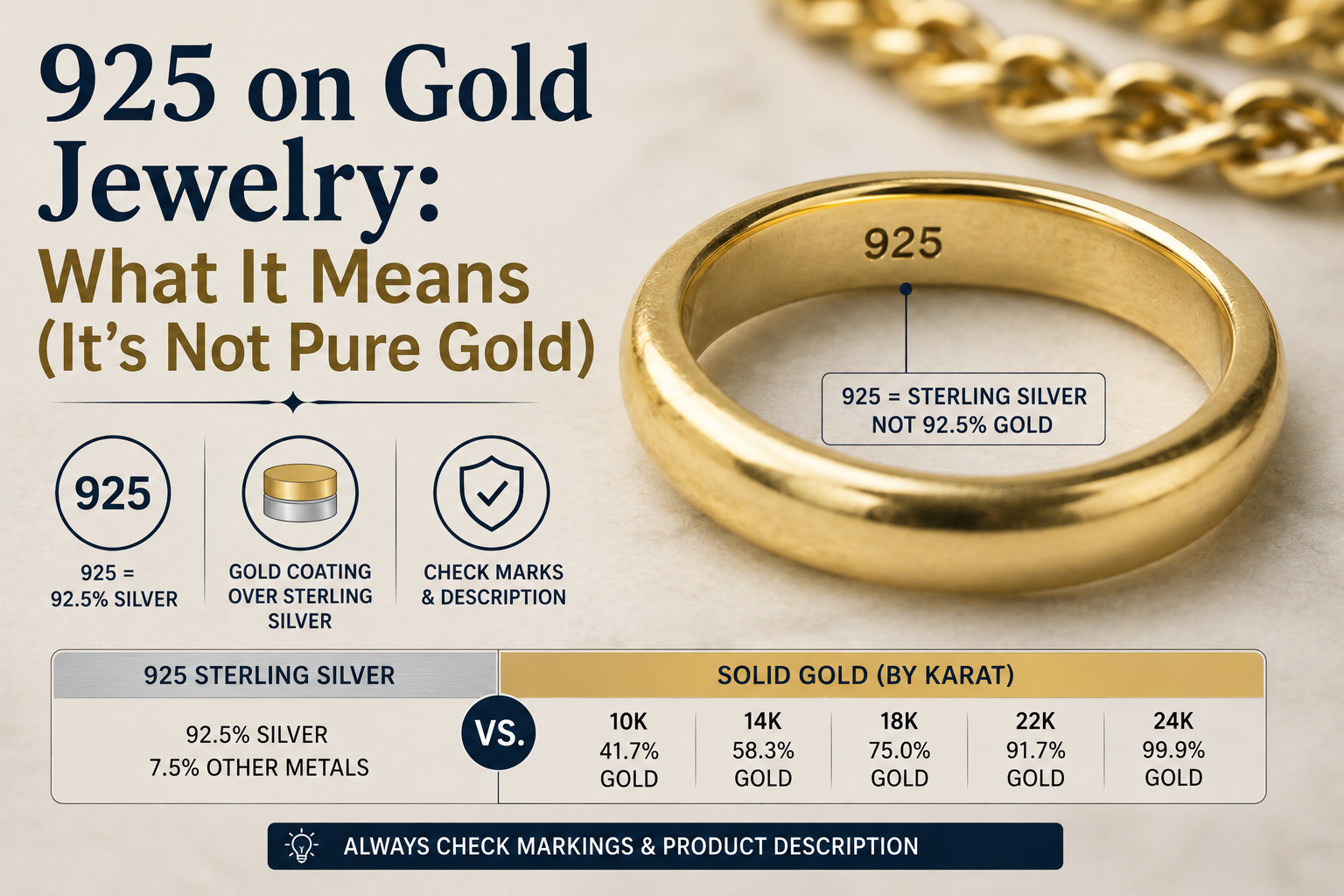
The 925 gold meaning is usually that the jewelry has a sterling-silver base, not that it contains 92.5% gold. A 925stamp means the marked metal is represented as 925 parts silver per 1,000, or 92.5% silver.
If the jewelry looks yellow or rose gold, it may have a gold coating over sterling silver. The 925 stamp itself, however, does not tell you what that coating contains.
Finding 925 on gold-colored jewelry also does not automatically mean you were ripped off. If the seller described the piece as gold-plated sterling silver or qualifying gold vermeil, the stamp can be consistent with what you purchased. If it was sold as solid gold, you have a reason to investigate.
Does 925 Mean Gold or Silver?
925 is a sterling-silver fineness mark, not a conventional solid-gold purity mark.
FTC consumer guidance states that silver products may be marked 925, meaning 925 parts per thousand are pure silver. Sterling silver contains 92.5% silver.
The calculation is:
925 ÷ 1,000 = 92.5% silver
Gold uses a different purity system. Karats express pure gold as parts out of 24. For example, FTC guidance explains that 18K jewelry contains 18 parts gold and six parts other metals.
| Mark | Gold Content | Description |
|---|---|---|
| 10K | 41.7% | 10-karat gold |
| 14K | 58.3% | 14-karat gold |
| 18K | 75.0% | 18-karat gold |
| 22K | 91.7% | 22-karat gold |
| 24K | Nearly pure gold | 24-karat gold |
| 925 | 92.5% silver | Sterling-silver fineness |
You may also encounter gold fineness numbers such as 585 for approximately 58.5% gold or 750 for 75% gold.
If a yellow-colored piece carries only a 925 precious-metal fineness mark, do not interpret that as 92.5% gold.
For more on the silver alloy, see what 925 sterling silver is.
Why Does My Gold Jewelry Say 925?
A gold-colored piece may say 925 because sterling silver sits underneath its colored surface.
Manufacturers can coat sterling silver with gold, creating jewelry that has a gold appearance while retaining a silver base.
Possible descriptions include:
- Gold-plated sterling silver
- Gold over sterling silver
- Gold vermeil
These terms do not all mean exactly the same thing.
FTC consumer guidance describes vermeil as a special type of gold-plated product with a sterling-silver base. Under the FTC Jewelry Guides, jewelry described as vermeil has a sterling-silver base coated on significant surfaces with gold or gold alloy of at least 10K and a minimum equivalent thickness of 2.5 microns.
A gold-colored piece stamped 925 does not automatically qualify as vermeil. The gold layer must meet the applicable requirements.
Likewise, the 925 mark alone does not prove that the yellow surface contains gold. Additional markings, seller documentation, or testing may be necessary.
Did I Get Ripped Off If My Gold Ring Says 925?
Not necessarily. Compare the 925 stamp with what the seller actually promised you.
If the listing or receipt says gold-plated sterling silver, a 925 stamp is consistent with that description.
If the item was accurately sold as qualifying gold vermeil, a sterling-silver base is also expected.
The situation is different if you paid for a piece represented as solid 14K, 18K, or another solid-gold alloy and discover a 925 mark instead.
FTC consumer guidance recommends checking jewelry markings and getting seller claims in writing. Gold jewelry should have a karat quality mark showing how much pure gold it contains.
Check your:
- Product listing
- Receipt or invoice
- Certificate or product card
- Packaging
- Seller’s description of the metal
Look specifically for terms such as gold plated, gold over sterling, vermeil, sterling silver, or 925.
If the written description says solid gold but the markings suggest sterling silver, ask the seller for an explanation. For an expensive purchase, have the item independently tested before deciding what happened.
Does 925 Mean 22K Gold?
No. 925 does not mean 22K gold.
The confusion comes from interpreting 925 as 92.5% gold.
Twenty-two-karat gold contains:
22 ÷ 24 × 100 ≈ 91.67% gold
By contrast:
925 sterling = 92.5% silver
The percentages happen to be close, but they describe different metals and different marking systems.
A seller using the phrase “925 gold” may mean gold-colored or gold-plated 925 sterling. Read the full product description rather than assuming 925 identifies gold purity.
What Is the Difference Between Gold-Plated Sterling and Vermeil?
Vermeil is a specific type of gold-plated sterling silver with defined coating requirements under U.S. FTC guidance.
Both can contain genuine silver and genuine gold, but not every gold-plated sterling piece qualifies as vermeil.
| Feature | Gold-Plated Sterling | Gold Vermeil |
|---|---|---|
| Base | Sterling silver | Sterling silver |
| Gold coating | May vary | Gold or gold alloy |
| Minimum gold fineness for term | Depends on specific claim | At least 10K |
| Minimum vermeil thickness | Not applicable | 2.5 microns equivalent |
| Can carry 925 | Yes | Yes |
| Solid gold | No | No |
FTC guidance defines vermeil as sterling silver coated on significant surfaces with gold or gold alloy of at least 10K and at least 2.5 microns equivalent thickness.
That distinction matters if a seller charges a premium for “vermeil” rather than ordinary gold-plated sterling.
How Can You Check 925 Gold Jewelry?
Start with the complete set of markings and compare them with the seller’s written description.
Use a magnifying glass to inspect the inner ring band, clasp, pendant back, or other small surfaces.
You might find marks such as:
925
.925
STERLING
925 ITALY
along with maker or coating marks.
Our sterling silver hallmarks guide can help you interpret unfamiliar symbols.
Next, inspect high-wear areas. If the yellow surface has worn away to reveal a silver-colored metal underneath, that is consistent with a plated white-metal base, although appearance alone cannot prove the exact metals involved.
Do not rely on a magnet as an authentication test. Gold and silver are not strongly magnetic, but many non-precious metals are also nonmagnetic.
For a valuable item, professional metal analysis provides stronger evidence. Surface coatings can complicate testing, so the person performing the test should know that the jewelry may be plated.
Is 925 Gold Jewelry Worth Anything?
Genuine gold-plated 925 sterling has intrinsic silver value, but it should not be valued as though its full weight were solid gold.
If a 20-gram piece consists primarily of sterling alloy, its theoretical silver content is:
20 g × 0.925 = 18.5 g silver
Converted to troy ounces:
18.5 ÷ 31.1035 ≈ 0.595 troy oz silver
[LIVE_PRICE_EMBED]
Do not include gemstone weight or substantial non-sterling components when estimating silver content.
The gold coating may also contain genuine gold, but you cannot calculate its gold content from total jewelry weight alone. You would need information about the coating’s thickness, fineness, and surface area.
Brand, design, craftsmanship, and condition can also make a finished piece worth more than its raw metal content.
Use our sterling silver calculator to estimate the underlying silver value when you know the relevant sterling weight.
Frequently Asked Questions
Is 925 gold fake?
No. The phrase can describe real sterling silver with a gold-colored or genuine gold coating, but 925 itself refers to silver rather than gold purity.
Whether the item was misrepresented depends on how the seller described it.
What does 925 mean on a gold ring?
A 925 stamp means the marked metal is represented as 92.5% silver.
If the ring looks gold, it may have a surface coating over sterling. The stamp alone does not identify that coating.
Can real gold have a 925 stamp?
A piece can contain real gold and carry a 925 stamp if the underlying metal is sterling silver and gold has been applied to its surface.
The 925 mark describes the silver base, not the gold coating’s purity.
Is 925 the same as 22K gold?
No. 925 represents 92.5% silver, while 22K represents approximately 91.7% gold.
They are different precious-metal standards despite the relatively close percentages.
The Bottom Line
The 925 gold meaning is not 92.5% gold. A 925 stamp identifies a claim of 92.5% silver fineness, and a gold-colored piece carrying that mark may have a coating over a sterling-silver base.
That does not mean the jewelry is fake or that the seller necessarily misled you. The key question is whether the item was accurately sold as plated sterling, vermeil, or solid gold.
If jewelry sold to you as solid gold carries only a 925 fineness mark, compare it with the written product description and consider independent testing. For other numbers or symbols on the piece, use our sterling silver hallmarks guide.