A sterling silver necklace uses sterling components containing 92.5% silver, and choosing the right one comes down to length, style, width, weight, construction, and whether you plan to wear a pendant. A 925 mark indicates sterling fineness, but you should also check the seller’s material description and specifications.
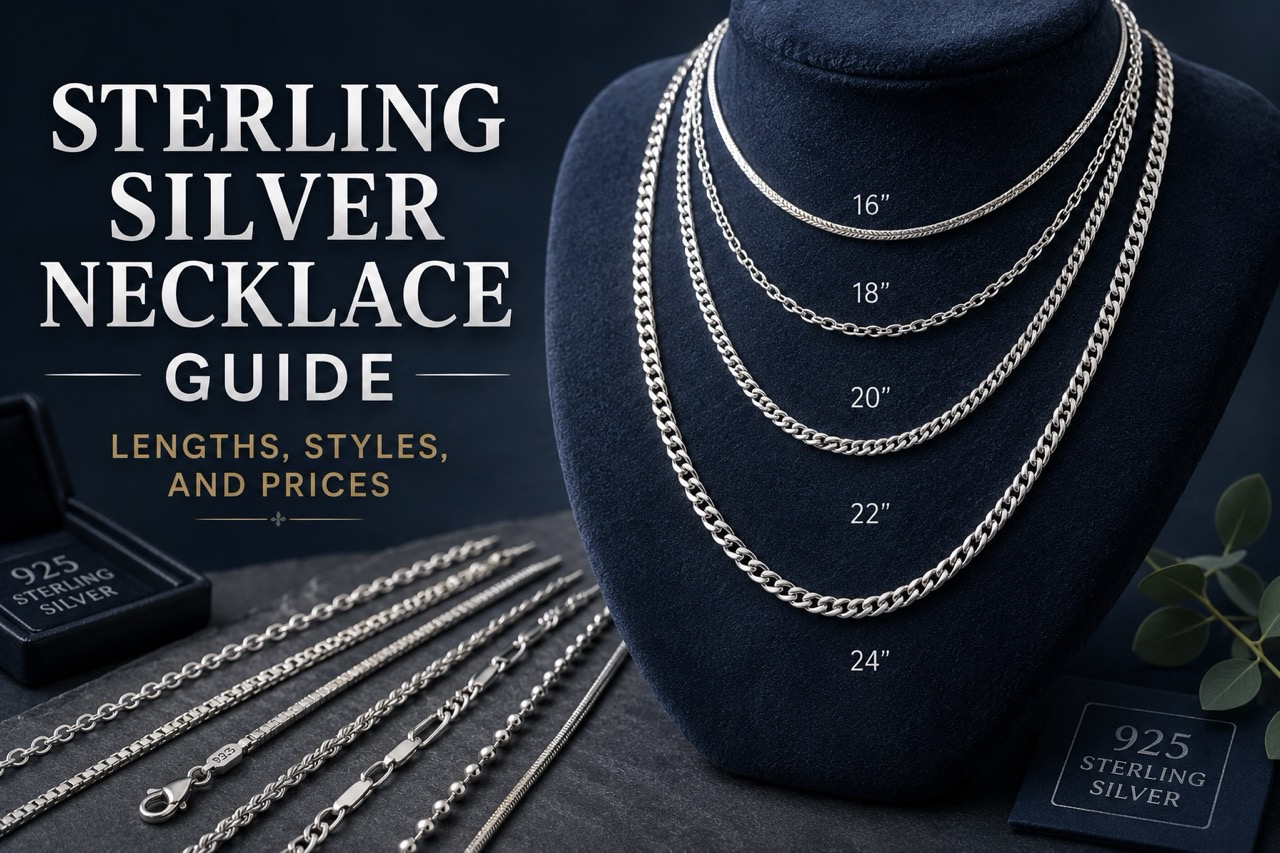
Common necklace lengths run from 16 to 24 inches, with longer designs reaching 30 inches or more. Prices vary widely because a lightweight chain, heavy solid necklace, and gemstone pendant can all use sterling silver while containing different amounts of metal and requiring different levels of workmanship.
Here’s what to compare before buying.
What Does 925 Mean on a Sterling Silver Necklace?
A 925 mark means the marked sterling component contains 92.5% silver by weight.
The FTC explains that sterling silver contains 92.5% pure silver and that 925 represents 925 parts of silver per 1,000.
The remaining 7.5% consists of alloying metals, commonly copper. Fine silver, by comparison, is generally 99.9% silver.
Common sterling markings include:
925.925STERLINGSTER
On a necklace, look near the clasp, end tag, or back of the pendant.
A 925 stamp is useful evidence, but don’t rely on it alone. Check the product description, seller, construction, and maker identification as well.
If your necklace carries unfamiliar letters, numbers, or symbols, use our silver hallmarks guide.
What Sterling Silver Necklace Length Should You Choose?
Choose necklace length according to your neck circumference, clothing, pendant size, and where you want the piece to sit.
Use these common lengths as starting points:
| Length | Approximate Position |
|---|---|
| 14 inches | Very close to the neck on many adults |
| 16 inches | Near the base of the neck |
| 18 inches | Around the collarbone |
| 20 inches | At or below the collarbone |
| 22 inches | Below the collarbone |
| 24 inches | Upper chest |
| 26–30+ inches | Longer chest-length look |
These positions are approximate. Neck circumference and body proportions can make the same necklace sit differently on two people.
The most reliable sizing method is to measure a necklace you already own and like. Lay it flat and measure from end to end.
For a sterling silver pendant necklace, include the pendant when considering final placement. A pendant adds length below the chain itself.
Should You Choose 16, 18, or 20 Inches?
An 18-inch necklace is a useful middle option for many adults, but your preferred fit matters more than a generic sizing chart.
A 16-inch necklace generally sits higher, while a 20-inch necklace gives more room below the neckline.
If you’re buying a gift and cannot measure the wearer, an adjustable chain or extender gives more flexibility. Check the actual minimum and maximum measurements before ordering.
Which Sterling Silver Necklace Style Is Best?
Choose the style based on whether you want to carry a pendant, wear the necklace alone, or create a particular link pattern.
| Style | Appearance | Common Use |
|---|---|---|
| Cable | Simple round or oval links | Pendants |
| Curb | Flattened interlocking links | Pendants or standalone |
| Figaro | Short links alternating with long links | Standalone or layered |
| Rope | Twisted spiral appearance | Standalone or pendants |
| Box | Square interconnected links | Pendants |
| Wheat | Interwoven symmetrical links | Pendants or standalone |
| Snake | Smooth, closely connected surface | Pendants, sleek styling |
| Ball | Connected metal beads | Pendants, casual designs |
No style is automatically the strongest. Width, link thickness, soldering, construction, and manufacturing quality all affect durability.
Cable and Box Necklaces
Cable and box chains are useful when you want the pendant to remain the focal point.
Cable chains use round or oval links. Box chains use square interconnected links that create a more geometric appearance.
For either type, make sure the chain is appropriately sized for the pendant’s weight.
Curb and Figaro Necklaces
Curb and Figaro chains have more visible link patterns and often work well without a pendant.
Curb links twist so they lie relatively flat. Figaro chains use a repeating combination of short and elongated links.
Both styles come in fine and heavy versions, so check the actual millimeter width.
Rope, Wheat, and Snake Necklaces
These styles provide more texture or a smoother visual surface than basic cable chains.
Rope chains use twisted components, while wheat chains have an interwoven structure. Snake chains create a smooth surface with few visible open links.
Avoid sharp bends in snake chains because the closely connected structure can kink.
What Width Should a Sterling Silver Necklace Be?
Width determines how visually substantial a necklace appears, but style and construction also affect its appearance and weight.
| Width | General Appearance |
|---|---|
| 1–2 mm | Fine and understated |
| 2–4 mm | Moderate |
| 4–6 mm | Substantial |
| 6 mm+ | Bold |
These are shopping guidelines rather than standardized categories.
A 3 mm rope chain and 3 mm box chain will not necessarily look or weigh the same.
For pendant necklaces, check the bail, the loop connecting the pendant to the chain. The chain’s clasp and end fitting must pass through the bail opening.
Also consider pendant weight. A heavy pendant needs a chain with suitable dimensions and construction.
Solid vs. Hollow Sterling Silver Necklaces
A solid sterling necklace contains more metal than a comparable hollow design, while hollow construction reduces weight and can reduce cost.
“Solid sterling” does not mean pure silver. It describes construction: the component is sterling throughout rather than a base-metal piece covered with a silver layer.
Hollow jewelry contains internal empty space.
| Construction | Main Advantage | Main Tradeoff |
|---|---|---|
| Solid sterling | More metal, heavier feel | Usually higher price and weight |
| Hollow sterling | Larger appearance with less weight | More susceptible to dents or crushing |
| Silver plated | Lower initial price | Silver layer can wear through |
The FTC distinguishes silver plate from sterling: plated jewelry has a layer of silver applied over a base metal.
Hollow jewelry is not automatically poor quality. It can be useful when you want a larger necklace without the weight of a comparable solid piece.
Gram weight helps you compare necklaces with similar dimensions.
How Can You Tell If a Sterling Silver Necklace Is Real?
Start with the hallmark and seller’s material description, then consider professional testing if authenticity remains uncertain.
A genuine 925 silver necklace may carry 925, .925, or a sterling designation near the clasp or pendant.
Do not confuse these descriptions:
| Description | Meaning |
|---|---|
| 925 sterling silver | 92.5% silver |
| Fine silver / 999 | Approximately 99.9% silver |
| Silver plated | Silver layer over another material |
| Silver-tone | Describes color, not silver content |
| German silver | Copper-based alloy containing no silver |
| Nickel silver | Copper-zinc-nickel alloy containing no silver |
A magnet can provide limited screening. Strong magnetic attraction raises questions because silver itself is not strongly magnetic.
However, a chain that does not stick to a magnet is not automatically sterling. Many other metals are also nonmagnetic.
For an expensive necklace or a piece with questionable markings, professional precious-metal testing provides stronger evidence than home tests.
Read our 925 sterling silver guide for more identification information.
How Much Does a Sterling Silver Necklace Cost?
There is no standard retail price because weight, construction, craftsmanship, gemstones, design, brand, and seller markup all affect cost.
If the sterling weight is available, you can estimate the theoretical value of its silver content.
Use:
current silver spot price ÷ 31.1035 × 0.925 = silver value per gram of sterling
Then multiply that figure by the sterling weight.
[LIVE_PRICE_EMBED]
A 40-gram sterling necklace, for example, contains approximately:
40 × 0.925 = 37 grams of silver
Its theoretical contained-silver value therefore equals 37 grams of silver at the current spot price.
That figure is not the same as retail value. Manufacturing, finishing, clasps, gemstones, labor, design, distribution, branding, and retailer margins contribute to the final price.
Use our live silver price when comparing a necklace’s asking price with its approximate contained-silver value.
What Should You Check Before Buying?
Check exact specifications rather than relying on enlarged photographs or the word “silver” in a product title.
Before ordering:
- Material: Confirm 925 sterling rather than silver plate or silver-tone.
- Length: Check the full measurement and any extender.
- Width: Look for an exact millimeter measurement.
- Weight: Gram weight helps compare similar necklaces.
- Construction: Determine whether it is solid, hollow, or plated.
- Clasp: Check the clasp style and dimensions.
- Hallmark: Look for an appropriate fineness mark and maker identification.
- Pendant: Check its dimensions, weight, bail, and material separately.
- Gemstones: Check whether stones are natural, lab-grown, or simulated if that distinction matters to you.
- Returns: Review the seller’s terms before ordering.
If a necklace includes a pendant, verify the materials of both the chain and pendant rather than assuming they are identical.
How Do You Care for a Sterling Silver Necklace?
Keep sterling dry and clean, reduce exposure to sulfur-containing gases, and polish only when necessary.
Silver tarnishes when it reacts with sulfur-containing gases. Tarnish on pure silver consists of silver sulfide, while sterling tarnish can also contain copper sulfide.
Darkening is therefore not evidence that your necklace is fake.
After wearing a necklace, wipe it gently with a clean, soft cloth before storage. Enclosed storage helps reduce exposure to tarnishing gases.
For lightly tarnished plain sterling, a silver polishing cloth can help. CCI describes polishing cloths as relatively gentle but confirms that polishing is still abrasive.
Avoid frequent or aggressive polishing. Tarnish removal can remove some underlying silver, and repeated polishing can gradually alter the surface.
Use extra care with pearls, porous gemstones, intentional oxidation, plated components, enamel, and glued decorations. A cleaning method suitable for plain sterling may damage those materials.
Frequently Asked Questions
Is a 925 silver necklace real silver?
Yes. A genuine 925 silver necklace contains 92.5% silver in its sterling components.
The FTC confirms that 925 represents 925 parts silver per thousand.
What are the most common sterling silver necklace lengths?
Common sterling silver necklace lengths include 16, 18, 20, 22, and 24 inches, with longer designs extending to 30 inches or more.
Actual fit depends on neck circumference, body proportions, clothing, and pendant size.
Is a sterling silver pendant necklace good for everyday wear?
A well-made sterling silver pendant necklace can work for regular wear when the chain is appropriately sized for the pendant.
Check the clasp, bail, chain, and connection points periodically for wear or damage.
Does a sterling silver necklace turn black?
Yes. Sterling can develop dark tarnish.
Silver sulfide forms as silver reacts with sulfur-containing gases, and thicker tarnish can become black.
Is sterling silver better than silver plate for a necklace?
Sterling contains 92.5% silver throughout its sterling components, while silver-plated jewelry has a silver layer applied over another metal.
Sterling therefore contains substantially more precious metal, while plated jewelry can provide a similar initial appearance at a lower price.
The Bottom Line
A good sterling silver necklace combines genuine 92.5% silver with the right length, width, style, weight, and construction for how you plan to wear it. Exact measurements matter more than enlarged product photographs, especially when buying online.
For pendant necklaces, check the bail, chain dimensions, pendant weight, and materials of both components. For standalone necklaces, compare link style, width, gram weight, and solid versus hollow construction.
Before buying, use our 925 sterling silver guide and silver hallmarks guide to help distinguish genuine sterling from plated and silver-colored jewelry.