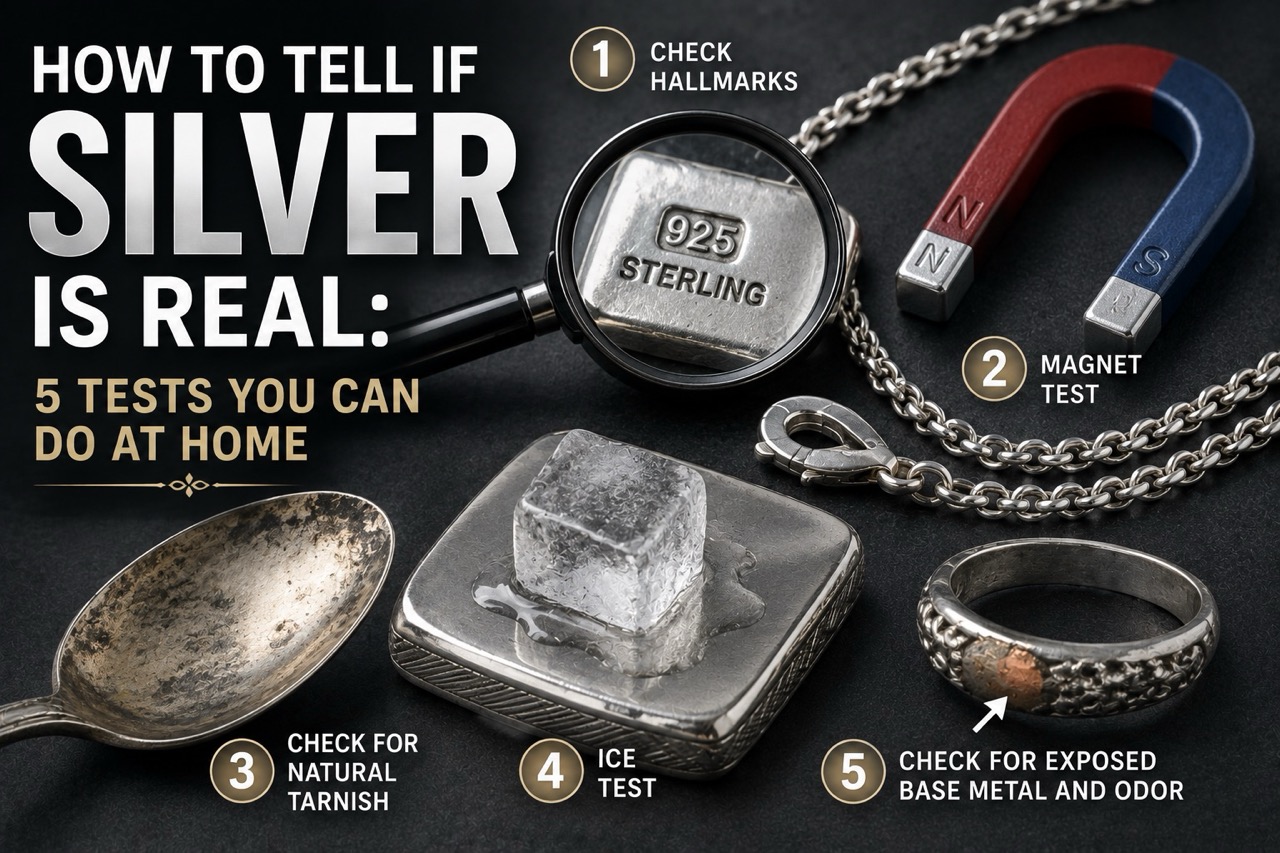
The safest way to tell if silver is real at home is to combine several non-destructive checks: inspect the hallmarks, test for strong magnetic attraction, examine the surface for natural tarnish, compare heat transfer with ice, and look for signs of exposed base metal or an unusual metallic odor. No single home test proves that an item is silver or tells you its exact purity.
Start with the hallmark because marks such as 925 and STERLING provide useful information about claimed fineness. Then use the other tests as supporting evidence.
If the item could be valuable, antique, collectible, or silver plated, avoid filing, scratching, acid testing, or aggressive polishing just to identify it.
1. Check the Silver Hallmarks
Hallmarks are the best place to start because they can identify the silver fineness claimed for the piece.
Common marks include:
| Mark | Typical Meaning |
|---|---|
925 or .925 | 92.5% silver |
STERLING | Sterling silver |
999 or .999 | Approximately 99.9% silver |
800 | 80% silver |
EPNS | Electroplated nickel silver |
SILVER PLATE | Silver applied over another metal |
The FTC states that sterling silver contains 92.5% pure silver and that 925 means 925 parts out of 1,000 are silver.
On jewelry, check the inside of a ring, the clasp or end tag of a chain, and the back of a pendant. Larger silver objects often carry marks on their undersides.
In the U.S., the FTC also states that silver items carrying a quality mark should show the name or U.S. registered trademark of the company or person responsible for the mark.
A hallmark still isn’t proof by itself. Marks can be copied or misapplied.
Use our silver hallmarks guide if you find letters, numbers, or symbols you don’t recognize.
2. Try the Magnet Test
Silver should not show the strong attraction to a magnet that you would expect from ferromagnetic metals such as iron.
To perform a simple check:
- Use a reasonably strong magnet.
- Bring it close to several areas of the object.
- Watch for strong attraction from the main body of the piece.
If a supposedly solid silver object snaps strongly toward the magnet, that is a warning sign that magnetic metal is present.
However, passing the magnet test does not prove the item is silver.
Copper and many other non-silver metals also lack strong magnetic attraction. A counterfeit object made from one of those materials can pass this test.
Jewelry may also contain small components made from other metals. A spring inside a clasp, for example, can react differently from the sterling chain attached to it.
Use the magnet test to identify suspicious pieces, not to certify genuine ones.
3. Look for Natural Tarnish
Genuine silver commonly tarnishes, so characteristic surface discoloration can provide another clue.
Silver reacts with sulfur-containing gases in the environment. Pure silver forms silver sulfide, while tarnish on sterling can also contain copper sulfide.
Tarnish does not always begin black. Thin tarnish can appear yellow, red-brown, blue, or iridescent before a thicker layer becomes black.
That means a blackened sterling ring or spoon is not automatically fake.
The reverse also applies: silver does not have to be tarnished. A recently polished piece or one protected from tarnishing gases may remain bright.
Avoid polishing an antique, collectible, or plated object merely to see whether black residue comes off. The Canadian Conservation Institute warns that polishing removes some underlying silver, and repeated polishing can damage or remove thin silver plating.
Tarnish is supporting evidence, not an authentication test.
4. Try the Ice Test
Silver transfers heat rapidly, so an ice cube placed against a substantial silver object can begin melting quickly.
This test is easiest with larger pieces such as bars, coins, flatware, or substantial jewelry.
To try it:
- Let the object reach room temperature.
- Place an ice cube directly against it.
- Compare the response with an object of similar size made from another known material.
Rapid heat transfer is consistent with silver.
The limitation is significant: fast heat transfer is not unique to silver. Other metals can also conduct heat efficiently.
Object size, thickness, starting temperature, and contact area also affect what you see. The test is particularly weak for tiny earrings and fine chains.
Treat fast ice melting as another clue rather than proof.
5. Check for Exposed Base Metal and Odor
Visible wear through a silver-colored surface is more useful than smell alone when checking for silver plate.
Examine areas that receive the most friction:
- Ring interiors
- Chain clasps
- Corners and edges
- Raised details
- Bracelet links
- Areas that rub against skin or clothing
If a differently colored metal appears underneath a silver-colored surface, the item is probably plated rather than sterling throughout that component.
The FTC distinguishes silver plate from sterling silver: silver-plated jewelry has a layer of silver applied to a base metal.
You can also check for a strong metallic odor, but give this observation very little weight. Skin oils, perfume, cleaning products, storage materials, and exposed non-silver components can all affect smell.
Odor by itself is not a reliable real silver test.
Which Home Silver Test Is Most Reliable?
No single home test reliably proves that an object is silver, so combine several independent clues.
| Test | Useful For | Main Limitation |
|---|---|---|
| Hallmark | Identifying claimed fineness | Marks can be false |
| Magnet | Detecting strongly magnetic metal | Many non-silver metals pass |
| Tarnish | Identifying behavior consistent with silver | Tarnish is not unique proof |
| Ice | Observing rapid heat transfer | Other metals conduct heat well |
| Surface inspection | Finding worn plating or base metal | Unworn plating may hide the core |
| Odor | Weak supporting clue | Highly subjective |
For how to test silver at home, the best sequence is usually:
hallmark → visual inspection → magnet → tarnish assessment → heat-transfer test
If all of those observations are consistent with sterling, you have stronger evidence than any one test provides.
You still have not established an exact silver percentage.
What About Silver Acid Tests?
Acid testing can provide additional information, but it can damage the object and involves corrosive chemicals.
Traditional methods may require scratching the item onto a testing stone or filing through the surface before applying a testing solution.
That creates a particular problem with silver plate. Testing only the surface may detect real silver even though the underlying object is base metal.
Do not scratch, file, or apply acid directly to a valuable coin, antique, collectible, or piece of jewelry simply to satisfy curiosity.
If the object’s value depends on its composition, professional testing is the better next step.
A jeweler, precious-metal buyer, or assay service may have access to X-ray fluorescence, or XRF, and other analytical methods. XRF can provide elemental information without the traditional scratch used for acid testing, although proper equipment and interpretation still matter.
How Can You Tell Sterling Silver From Silver Plate?
Sterling silver contains 92.5% silver throughout the sterling component, while silver plate has a silver surface layer over another metal.
The FTC defines sterling as 92.5% pure silver and describes silver plate as a layer of silver applied to a base metal.
Start with the marks. 925 and STERLING indicate claimed sterling fineness, while marks such as EPNS point toward plating.
Then examine areas that receive the most wear. Base metal showing through the silver-colored surface is strong evidence of plating.
Do not intentionally file through the surface to find out. This damages the object and is especially risky with thin silver plate.
When Should You Get Silver Professionally Tested?
Professional testing makes sense when the item’s authenticity materially affects its value.
Consider it when:
- The object may be valuable or antique.
- The hallmark appears suspicious.
- There is no hallmark.
- You suspect silver plating.
- Your home tests give conflicting results.
- You plan to buy or sell based on silver content.
- You need to know the alloy’s actual composition.
Professional testing is also preferable for collectible coins. Cleaning, scratching, filing, or acid testing a collectible coin can damage its surface and hurt its numismatic value.
Once you’ve confirmed that an item is sterling and know its weight, use our sterling silver calculator to estimate its contained-silver value.
Frequently Asked Questions
How can you tell if 925 silver is real?
For how to tell if 925 silver is real, start with the 925 mark, inspect the piece for worn plating, and check that its main body does not show strong magnetic attraction.
A 925 stamp alone does not establish authenticity. Professional metal analysis provides stronger evidence when purity or value matters.
What is the easiest way to test silver at home?
The easiest first check is the hallmark.
Look for 925, .925, or STERLING, then examine the surface and use a magnet as secondary checks. No single home test should be treated as proof.
Does real silver stick to a magnet?
Silver does not show strong attraction to an ordinary magnet.
Strong attraction from the main body of an item is therefore suspicious, but a nonmagnetic result does not prove the item is silver.
Does real silver turn black?
Yes. Genuine silver can develop black tarnish as silver reacts with sulfur-containing gases and forms silver sulfide.
Thin tarnish can show other colors before becoming black.
Can fake silver have a 925 stamp?
Yes. A fineness mark should be treated as evidence of what the item claims to be, not as independent proof of composition.
If the piece is valuable or the mark appears suspicious, professional testing is the safer way to confirm the metal.
The Bottom Line
If you’re checking how to tell if silver is real, start with the hallmark and combine it with a visual inspection, magnet check, tarnish assessment, and ice test. Agreement between several checks gives you better evidence than relying on any one result.
Avoid scratching, filing, aggressive polishing, or applying acid to valuable jewelry, coins, antiques, and plated objects. If the answer affects what you plan to pay or sell the item for, have the metal professionally tested.
For your next step, use our silver hallmarks guide to identify the marks on your piece.