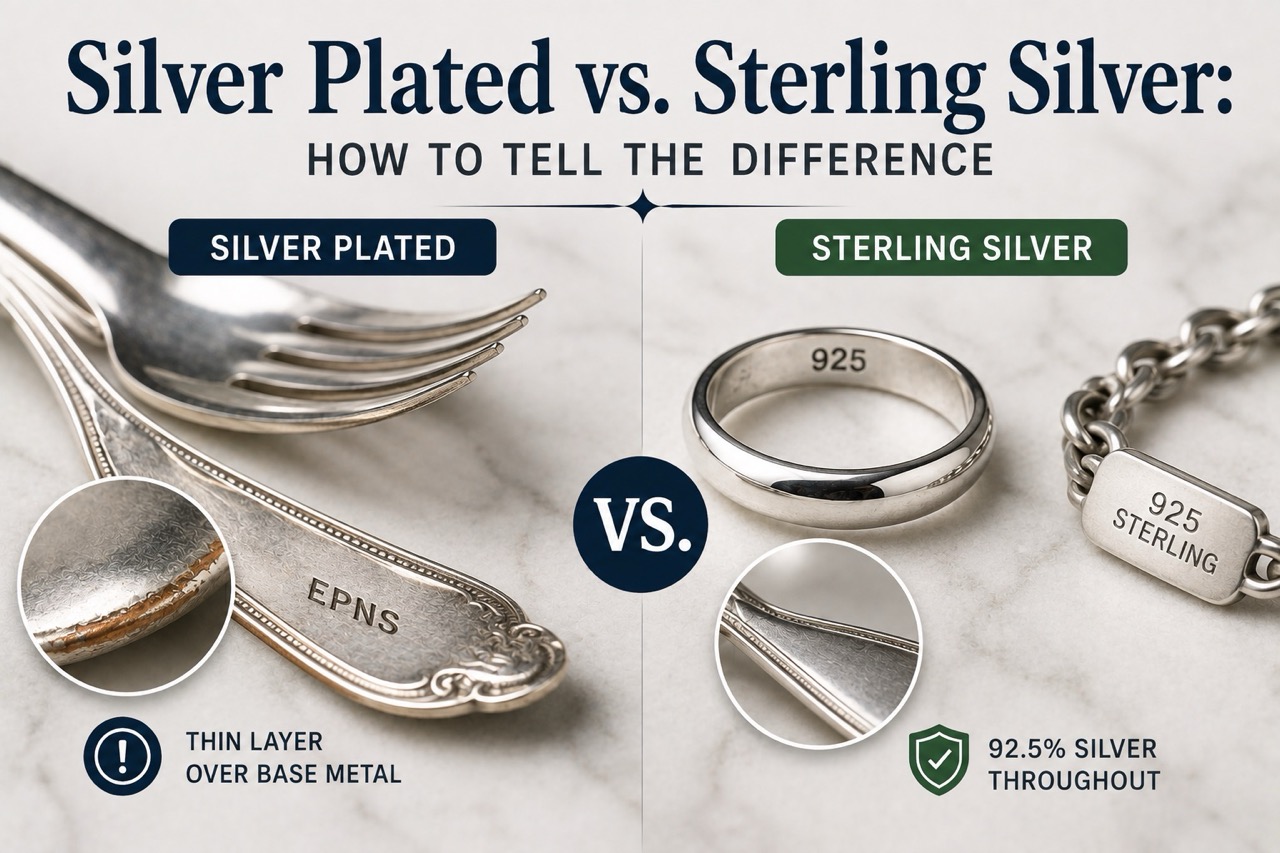
The main difference between silver plated vs sterling silver is silver content: sterling contains 92.5% silver, while silver plate has a layer of silver applied over another metal. FTC consumer guidance defines sterling as 92.5% pure silver and describes silver plate as silver applied over a base metal.
That difference affects value, wear, cleaning, and identification. Sterling has measurable precious-metal content throughout the qualifying alloy. On a plated piece, enough wear or polishing can eventually expose the material underneath.
Start with the markings, then inspect high-wear areas. If significant money is involved, professional testing is safer than relying on appearance or home tricks.
Silver Plated vs. Sterling Silver at a Glance
Sterling contains 92.5% silver throughout its qualifying alloy, while silver plate relies on a silver surface layer over another material.
| Feature | Sterling Silver | Silver Plated |
|---|---|---|
| Silver content | 92.5% | Varies with plating |
| Underlying material | Silver alloy | Usually a base metal |
| Common identification | 925, .925, STERLING | Plating or manufacturer marks |
| Precious-metal value | Significant | Usually much lower by weight |
| Can surface silver wear through? | Not applicable as ordinary plating | Yes |
| Tarnishes? | Yes | Yes, where silver is exposed |
| Polishing | Removes some silver | Can eventually remove plating |
| Best first identification step | Check fineness marks | Check marks and worn areas |
Silver plate is not fake silver in the sense that the surface coating can be genuine silver. The key distinction is how much silver the complete object contains.
What Is Sterling Silver?
Sterling silver is an alloy containing 92.5% pure silver.
Its basic composition is:
92.5% silver + 7.5% other metals
Copper commonly makes up much of the remaining alloy.
FTC guidance states that the words silver, sterling, and sterling silver describe products containing 92.5% pure silver. It also explains that 925 means 925 parts per thousand are silver.
Common sterling marks include:
925
.925
STERLING
STER
S925
Marking practices vary by country and period. In the United States, FTC guidance also says silver items should show the name or registered trademark of the company or person standing behind the fineness mark.
Unlike silver plate, sterling does not depend on a thin silver coating for its silver content. Scratch the surface of genuine solid sterling and the underlying alloy is still sterling.
See what 925 sterling silver is for more on composition and purity.
What Does Silver Plated Mean?
Silver plated means that silver has been applied as a surface layer over another material.
FTC consumer guidance describes silver plate as a layer of silver applied to a base metal.
The underlying material can vary. Copper alloys and nickel silver are among the materials historically used beneath silver plating.
Electroplating is one method used to deposit silver onto a metal surface.
The key point is that you cannot calculate a plated object’s silver content from its total weight.
For example, if a piece consists entirely of 50 grams of sterling alloy, its theoretical silver content is:
50 × 0.925 = 46.25 grams of silver
A 50-gram silver-plated object does not contain 46.25 grams of silver. Most of its weight may come from the underlying material, while the quantity of silver depends on the plating.
How Can You Tell Sterling Silver From Silver Plate?
Check the markings first, then examine areas where wear is most likely to expose an underlying metal.
Sterling marks commonly include:
925
.925
STERLING
Silver-plated objects can carry plating-related wording or abbreviations depending on the manufacturer, country, and period.
One mark you may encounter on older objects is:
EPNS — electroplated nickel silver
Nickel silver is a copper-nickel-zinc alloy rather than a genuine silver alloy. On an EPNS object, the silver is the electroplated surface.
Next, examine high-wear areas such as:
- Edges and rims
- Raised decoration
- Fork tines
- Spoon backs
- Ring edges
- Bracelet links
CCI specifically recommends looking for worn areas that may reveal the base metal underneath silver plating.
If a copper-colored or otherwise different metal appears beneath the silver-colored surface, plating is a strong possibility.
Do not damage an antique to find out. Filing or scratching an object can reduce its value.
Use our sterling silver hallmarks guide to interpret unfamiliar silver stamps.
Does a 925 Stamp Mean Silver Plated?
No. A legitimate 925 mark indicates a claim of 92.5% silver fineness, not ordinary silver plating.
FTC guidance confirms that 925 means 925 parts per thousand silver.
A stamp still should not be treated as conclusive proof by itself.
Counterfeit or misleading markings can exist, and an individual marked component does not automatically establish the composition of every part of a piece.
If you’re considering an expensive purchase and the markings do not match the item’s appearance or seller’s description, have it tested before paying a sterling price.
For valuable antiques, favor non-destructive identification methods whenever possible.
Do Sterling Silver and Silver Plate Tarnish?
Yes. Both can tarnish because both can have genuine silver exposed to the environment.
Silver tarnishes primarily when it reacts with sulfur-containing gases, producing silver sulfide. CCI notes that thin tarnish can display different colors before developing the familiar dense black appearance.
Silver plate can develop the same type of surface tarnish because its exposed coating is silver.
The important difference appears during cleaning.
Polishing is abrasive. CCI explains that every polishing removes some silver along with the tarnish. On plated objects, repeated polishing can damage the thin silver layer or remove it entirely.
That makes aggressive polishing especially risky for plated antiques and decorative objects.
Which Is Worth More: Sterling Silver or Silver Plated?
Sterling generally has much higher intrinsic silver value because 92.5% of the qualifying alloy is genuine silver.
At current silver spot prices:
[LIVE_PRICE_EMBED]
The theoretical sterling metal-value formula is:
sterling weight in grams × 0.925 ÷ 31.1035 × silver spot price
A 100-gram piece made entirely from sterling alloy therefore contains approximately:
92.5 grams of silver
Be careful with complete-object weight. Stones, weighted bases, filled handles, steel blades, and other non-sterling components should not be valued as silver.
A 100-gram silver-plated object cannot be calculated with the same formula because its total weight does not tell you how much silver was deposited on the surface.
Silver-plated objects can still have substantial market value. Maker, age, rarity, condition, design, and collector demand may matter much more than recoverable silver.
Use our sterling silver calculator for pieces whose sterling weight you know.
Is Silver Plated Jewelry Worth Buying?
Silver-plated jewelry can make sense if you want a lower purchase price and do not need substantial precious-metal content.
The tradeoff is surface wear.
Friction against skin, clothing, and other objects can gradually wear the plating. Rings and bracelets generally encounter more abrasion than pieces such as pendants, although actual plating life depends on thickness, use, care, and construction.
CCI’s conservation guidance demonstrates the same principle with plated objects: repeated abrasive polishing can remove enough silver to expose the base metal.
Sterling costs more but contains silver throughout the qualifying alloy. It therefore has more intrinsic precious-metal value and does not expose a base-metal core simply because its surface silver wears away.
Choose based on what matters more to you: lower upfront cost or substantial silver content.
Can You Test Silver at Home?
Home checks can provide useful clues, but no single simple test proves that an object is sterling.
Start with four non-destructive checks:
- Read the marks. Look for
925,STERLING, plating terminology, and maker’s marks. - Inspect worn areas. Different-colored metal showing beneath the surface can indicate plating.
- Check the construction. Look closely at edges, joints, clasps, handles, and other components.
- Research the maker. Manufacturer and pattern information can help interpret unfamiliar marks.
CCI likewise recommends examining identifying marks and worn areas before cleaning or treating a silver object.
Do not rely on magnetism alone. A weak or absent magnetic response does not prove sterling silver.
Avoid filing, scratching, bleach, or acid tests on valuable or collectible pieces. If knowing the composition affects a purchase, sale, or appraisal, professional testing is the safer choice.
Frequently Asked Questions
How do you tell if silver is real or plated?
Check the markings and high-wear areas first. 925 or STERLING indicates a sterling fineness claim, while exposed base metal or plating-related marks can point toward silver plate.
For a valuable object, professional testing provides stronger evidence than appearance alone.
Is silver plated worth anything?
Yes. Silver plated items can have value, but their value usually does not come primarily from recoverable silver.
Maker, age, rarity, condition, design, and collector demand can make certain plated objects valuable.
Is sterling silver better than silver plate?
Sterling silver vs silver plate comes down largely to silver content, price, and intended use.
Sterling is better if you want 92.5% silver content and intrinsic precious-metal value. Silver plate can be a lower-cost choice if appearance matters more than metal content.
Does silver plate wear off?
Yes. Silver plating can wear away through abrasion and repeated polishing.
CCI warns that excessive polishing can remove plating completely in some areas and expose the base metal underneath.
The Bottom Line
In the silver plated vs sterling silver comparison, sterling contains 92.5% silver throughout the qualifying alloy, while silver plate has a silver layer over another material. That gives sterling substantially more intrinsic silver value, while plated pieces can offer a similar surface appearance at a lower material cost.
Both can tarnish, but silver plate requires extra care because aggressive polishing can wear through its silver layer. A plated antique can also be valuable for reasons unrelated to its silver content.
If you have an unknown piece, start with its markings rather than damaging it with a home test. Use our sterling silver hallmarks guide to decode 925, STERLING, and other silver stamps.