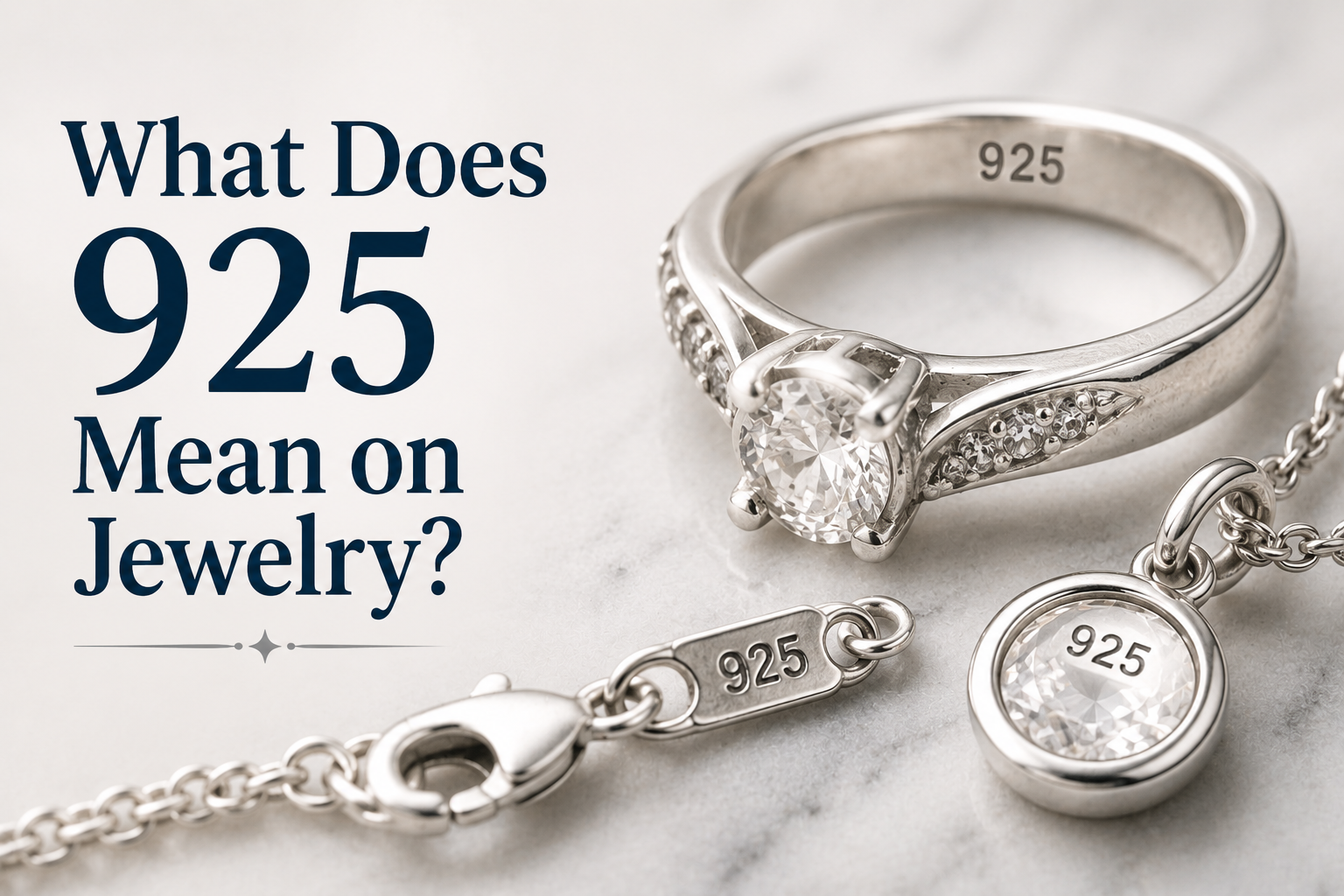
925 on jewelry means the piece is marked as having a silver fineness of 925 parts per 1,000, or 92.5% silver. That is the standard fineness for sterling silver. The remaining 7.5% consists of other metals, commonly including copper, which make the alloy harder than fine silver.
You will often find 925 inside rings, near necklace and bracelet clasps, or on the backs of pendants and earrings. The mark provides useful information about the claimed metal content, but a simple 925 stamp does not independently prove that a piece is genuine. Here’s how to interpret the mark and related stamps you may find on silver jewelry.
Does 925 Mean Real Silver?
Yes. A legitimate 925 mark indicates sterling silver with a fineness of 92.5% silver.
The number expresses silver content in parts per thousand:
| Mark | Silver Fineness | Percentage |
|---|---|---|
| 999 | 999/1,000 | 99.9% |
| 950 | 950/1,000 | 95% |
| 925 | 925/1,000 | 92.5% |
| 900 | 900/1,000 | 90% |
| 800 | 800/1,000 | 80% |
Of these, 925 is the standard associated with sterling silver. Other numbers identify different silver finenesses and should be interpreted according to the marking system and jurisdiction involved.
For example, 10 grams of 925 sterling alloy theoretically contains 9.25 grams of silver before accounting for stones, non-silver components, or other materials included in the item’s total weight.
The remaining 7.5% of sterling consists of alloying metals, commonly including copper. These metals increase hardness compared with 99.9% fine silver, making sterling practical for rings, chains, bracelets, clasps, and other jewelry.
For more on the alloy, see our guide to what 925 sterling silver is.
Why Is Sterling Silver Marked 925?
Sterling silver is marked 925 because the number represents 925 parts silver for every 1,000 parts of alloy.
You may see the same basic purity expressed in several forms:
- 925 — 925 parts silver per 1,000
- .925 — the same proportion written as a decimal
- 92.5% — the silver content expressed as a percentage
- STERLING — a word used to describe the sterling standard
The number refers to fineness, not weight.
A ring marked 925 does not contain 925 grams of silver, and the number does not indicate its size, model, price, or year of manufacture. It refers to the claimed proportion of silver in the alloy.
You may also see letters, names, logos, or symbols beside the number. Depending on the marking system, these can provide information about a manufacturer, sponsor, assay office, or origin.
Does a 925 Stamp Guarantee That Jewelry Is Real?
No. A 925 stamp is evidence of claimed fineness, but the stamp alone cannot authenticate an unknown piece of jewelry.
Anyone with the right equipment can physically stamp a number into metal. For that reason, you should distinguish a basic 925 fineness stamp from an official hallmark issued under a regulated assay system.
In the UK, for example, a complete hallmark includes three compulsory components: a sponsor’s or maker’s mark, a metal-and-fineness mark, and an assay-office mark. The assay office independently tests the precious metal before applying its hallmark.
Rules differ among countries, so do not expect every genuine sterling item to carry a UK-style hallmark.
For an unknown piece, examine all available markings rather than 925 alone. Wear that exposes a different-colored base metal underneath can also suggest that an item is plated rather than solid sterling.
A magnet provides only a limited screening test. Silver itself is not strongly attracted to a magnet, but many non-silver metals are also nonmagnetic. Passing a magnet test does not prove that jewelry is sterling silver.
For an expensive or uncertain item, professional testing by a qualified jeweler, appraiser, assay office, or precious-metals specialist provides stronger evidence.
Our sterling silver hallmarks guide can help you identify additional marks.
What Does 925 Italy Mean on Jewelry?
A “925 Italy” marking combines a claimed 925 silver fineness with an Italy origin marking. It does not represent a separate or higher grade of sterling silver.
The two parts serve different purposes:
925 refers to a claimed fineness of 92.5% silver.
Italy is an origin marking indicating that the piece is represented as Italian.
Do not interpret “Italy” as meaning that the silver is purer than sterling made elsewhere. A 925 fineness still represents 92.5% silver regardless of the stated country of origin.
The marking alone also should not be treated as independent proof of authenticity or origin. If the identity or value of a piece matters, examine its complete set of marks and supporting documentation.
Is 925 Silver Worth Anything?
Yes. Genuine 925 sterling has an underlying metal value because 92.5% of the alloy is silver.
Silver prices are commonly quoted per troy ounce. One troy ounce equals approximately 31.1035 grams.
To estimate the theoretical sterling value per gram:
Silver spot price ÷ 31.1035 × 0.925 = sterling silver value per gram
Once you have that sterling-per-gram figure, multiply it by the item’s sterling weight:
Item weight in grams × sterling silver value per gram = theoretical metal value
Alternatively, if you already know the current value of pure silver per gram, calculate:
Item weight in grams × 0.925 × pure silver value per gram = theoretical metal value
Do not apply the 0.925 adjustment twice.
These calculations estimate contained metal value rather than a guaranteed selling price. Stones and non-silver components can reduce the amount of sterling represented by an item’s total weight, while a dealer or refiner may pay less than theoretical metal value to cover processing costs and margin.
A finished piece can also sell for more than its silver content. Maker, design, craftsmanship, rarity, condition, and collector demand can add value beyond melt.
Use our sterling silver calculator to estimate an item’s silver value at current silver spot prices.
What Other Silver Marks Should You Know?
Silver-colored jewelry can carry several markings besides 925, and the number or abbreviation can change how you identify the piece.
999 or .999 indicates 99.9% silver fineness, commonly called fine silver.
950 represents 95% silver, while 900 represents 90% and 800 represents 80%. These numbers indicate silver finenesses different from the 925 sterling standard.
Plating marks require particular care. EPNS stands for electroplated nickel silver. Nickel silver is typically a copper, nickel, and zinc alloy rather than a silver alloy; an EPNS object gets its silver-colored precious-metal layer from electroplating.
Similarly, jewelry described as silver plate has a layer of silver over another metal rather than a solid sterling body.
That distinction has a major effect on melt-value calculations. You cannot treat the entire weight of a plated object as though 92.5% of it were silver.
Frequently Asked Questions
What does 925 mean on a ring?
A 925 mark on a ring indicates a claimed fineness of 92.5% silver, corresponding to sterling silver. The mark commonly appears inside the band.
A simple stamp is not independent proof of authenticity, so valuable or questionable rings may warrant professional testing.
Is 925 silver good quality?
925 sterling silver is a standard jewelry alloy containing 92.5% silver. The alloying metals make it harder than fine silver, which helps sterling withstand normal jewelry use.
Purity is only one part of quality. Construction, finishing, design, stone setting, and craftsmanship also affect how well a piece performs.
Does 925 silver tarnish?
Yes. Sterling silver can tarnish through reactions with sulfur-containing compounds in its environment, producing a dark surface layer.
Tarnish is not rust. Appropriate silver-cleaning methods can usually remove it without changing the underlying sterling alloy.
What does 925 mean on gold-colored jewelry?
A 925 mark on gold-colored jewelry can indicate sterling silver beneath a gold-colored coating. Gold-plated sterling is one possibility, and gold vermeil also uses sterling silver as its base metal under applicable definitions.
The 925 mark refers to the silver substrate, not the purity or thickness of the gold layer. Other markings or seller documentation may be necessary to identify the finish accurately.
Is 925 silver the same as white gold?
No. Sterling silver and white gold are different materials. Sterling contains 92.5% silver, while white gold consists of gold alloyed with other metals and is often rhodium-plated.
Gold purity is typically expressed using karat designations or corresponding gold fineness numbers rather than the sterling 925 standard.
The Bottom Line
If you’re asking what does 925 mean on jewelry, the number indicates a claimed silver fineness of 92.5%, which corresponds to sterling silver. It describes the proportion of silver in the alloy, not the jewelry’s weight, age, or market value.
Treat the stamp as an identification clue rather than automatic proof of authenticity. Use our sterling silver hallmarks guide to decode other markings, then check the sterling silver calculator if you want to estimate the metal value at current silver prices.