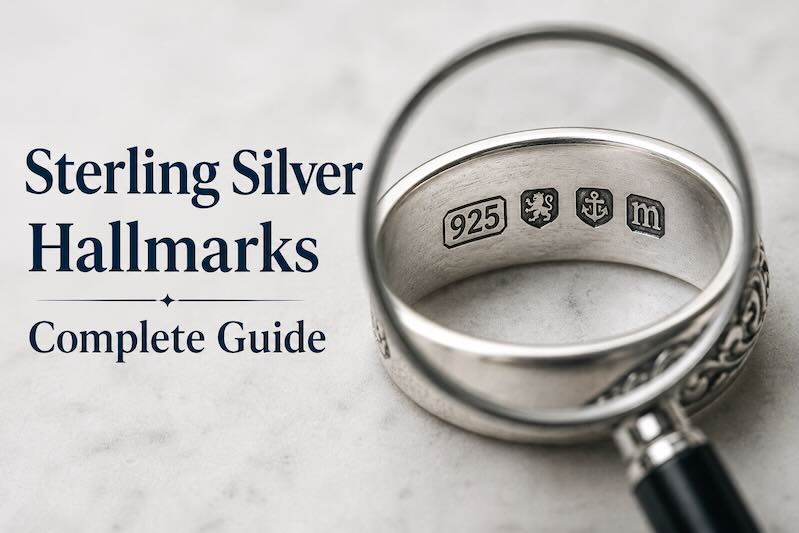
Sterling silver hallmarks and stamps can reveal an item’s silver purity, maker, origin, and, under some hallmarking systems, where and when it was tested. The familiar 925 mark means a stated fineness of 925 parts silver per 1,000, or 92.5% silver.
Not every mark on silver serves the same purpose. A simple 925 stamp is a fineness mark, while a legally recognized hallmark in countries with formal assay systems can consist of several symbols that provide independent verification.
Knowing the difference helps you identify jewelry, flatware, hollowware, and other silver objects more accurately.
What Do Sterling Silver Hallmarks Mean?
Sterling silver hallmarks can identify the purity of the metal and, depending on the hallmarking system, the sponsor or maker and the assay office that tested it.
The first step is to determine what type of mark you have.
| Mark or Mark Type | Typical Meaning |
|---|---|
| 925 / .925 | 92.5% silver fineness |
| STERLING | Sterling silver |
| 800 | 80% silver |
| 900 | 90% silver |
| 950 | 95% silver |
| Maker’s or sponsor’s mark | Identifies a maker, company, or registered sponsor |
| Assay-office mark | Identifies the office that tested and hallmarked an item |
| Country mark | Provides origin information |
| EP / EPNS | Indicates electroplating rather than solid sterling |
| Silver Plate | Silver coating over another metal |
A 925 mark describes fineness. It means the item claims to contain at least 925 parts silver for every 1,000 parts of alloy.
That equals 92.5% silver, with the remaining 7.5% made from other metals. Copper is commonly used in sterling alloys because pure silver is softer.
Read our guide to what 925 sterling silver is for a closer look at the alloy.
Is 925 the Same as Sterling Silver?
Yes. 925 is the standard fineness associated with sterling silver, representing 92.5% silver by weight.
You may encounter several markings on sterling items:
- 925 — 925 parts silver per 1,000
- .925 — the same fineness expressed with a decimal
- STERLING — a word mark indicating sterling silver
- STER — an abbreviation sometimes found on silver items
- 925 ITALY — a 925 fineness mark accompanied by an Italian origin marking
The words and numbers stamped on an object need context. A 925 stamp states a claimed fineness, but the stamp by itself does not provide the same assurance as an independently applied hallmark under a regulated assay system.
This distinction matters with unidentified jewelry. A counterfeit item can carry a false purity stamp, while genuine older silver may use a different marking system or have marks worn by decades of use.
How to Read Sterling Silver Hallmarks
Start by finding and recording every mark on the item. A jeweler’s loupe or magnifying glass helps because silver marks can be extremely small or partly worn.
Rings are commonly marked inside the band. Necklaces and bracelets often carry marks near the clasp or on a small tag, while flatware frequently has marks on the reverse of the handle.
1. Find the fineness mark
Look for 925, 950, 900, 800, or a word such as STERLING.
The number normally expresses silver content in parts per thousand. For example, 925 corresponds to 92.5% silver, while 800 corresponds to 80%.
2. Identify the maker’s or sponsor’s mark
Initials, names, logos, or symbols may identify a manufacturer, silversmith, or registered sponsor.
Do not treat a maker’s mark as proof of purity by itself. Its purpose is identification rather than stating how much silver the alloy contains.
3. Look for assay-office marks
Countries with formal hallmarking systems may use an assay-office symbol to identify where an item was tested.
The UK provides a clear example. A full UK hallmark has three compulsory components: a sponsor’s or maker’s mark, a metal-and-fineness mark, and an assay-office mark. A date letter may also appear, but it is optional.
4. Check for origin marks
A country name or national marking can provide another clue about where an object was manufactured or marked.
Interpret these marks according to the rules that applied in that country and period. Hallmarking systems are not identical worldwide.
5. Watch for plating marks
Marks such as EP, EPNS, and SILVER PLATE point toward a plated object rather than solid sterling.
For more examples, see our sterling silver hallmarks guide.
Which Marks Mean an Item Is Not Sterling Silver?
Marks identifying silver plate or fineness below 925 generally mean an item should not be classified as sterling based on that mark.
EPNS, for example, stands for electroplated nickel silver. Nickel silver is a copper-based alloy that typically contains nickel and zinc despite having the word “silver” in its name. The silver on an EPNS object comes from the plated surface rather than a solid sterling body.
Numbers below 925 can identify genuine silver alloys without identifying sterling silver.
An 800 mark indicates 800 parts silver per 1,000, or 80% silver. A 900 mark indicates 90% silver. Both contain less silver than the 92.5% sterling standard.
Condition also matters when reading marks. Stamps may be worn, incomplete, damaged, or misleading, so examine the complete set of markings before identifying an unfamiliar piece.
Do Hallmarks Tell You What Sterling Silver Is Worth?
A fineness mark can help you estimate an item’s silver content, but it cannot tell you the item’s full market value.
For sterling silver, the theoretical metal value starts with its 92.5% silver content. You can calculate an approximate value with:
Weight in grams × 0.925 × silver value per gram = theoretical silver value
Because silver spot prices are commonly quoted per troy ounce, you can also calculate the sterling value per gram as:
Silver spot price ÷ 31.1035 × 0.925 = sterling silver value per gram
[LIVE_PRICE_EMBED]
Melt value is only one measure of value. A piece by a sought-after silversmith or manufacturer may command a premium based on its maker, age, design, rarity, condition, or documented history.
Dealers and refiners also generally need a margin between the theoretical metal value and what they pay a seller. For that reason, an actual purchase offer may differ from the calculated silver value.
Use our sterling silver calculator to estimate metal value at current silver spot prices.
Can You Tell If Sterling Silver Is Real From the Mark Alone?
No. A 925 stamp is useful evidence, but it should not be your only authentication method for an unknown or valuable piece.
This is also where terminology matters. A manufacturer’s purity stamp and an official hallmark are not necessarily equivalent. In the UK, for example, a legally recognized hallmark provides independent verification from an assay office.
If an item’s authenticity affects a purchase, sale, insurance valuation, or appraisal, consider professional testing. A jeweler, appraiser, assay office, or precious-metal specialist can assess the item using methods appropriate to the piece.
Frequently Asked Questions
What does 925 mean on sterling silver jewelry?
A 925 mark represents a stated fineness of 925 parts silver per 1,000, equivalent to 92.5% silver.
That is the standard purity associated with sterling silver. The remaining 7.5% consists of other metals, commonly including copper.
Does sterling silver always have a 925 mark?
No. Sterling pieces may carry STERLING, other recognized fineness marks, or hallmarks used under national systems instead of a simple 925 stamp.
Older marks can also become worn or difficult to read. The absence of a visible 925 stamp does not, by itself, prove that an object is not sterling.
What does 925 Italy mean?
925 Italy indicates a stated fineness of 92.5% silver together with an Italian origin marking. “Italy” does not describe a separate or higher silver grade.
You should still consider the complete set of markings and the item’s authenticity rather than treating the stamp alone as proof.
Is 950 silver better than 925 silver?
950 silver contains more silver than 925 sterling: 95% compared with 92.5%.
Higher purity does not automatically make it better for every purpose. Alloy composition affects hardness, tarnish behavior, workability, and wear, so the best material depends on how the item will be used.
What does EPNS mean on silver?
EPNS means electroplated nickel silver. It describes an object made from a nickel-silver base with silver applied to its surface.
An EPNS item is therefore not solid sterling silver and should not be valued as though its full weight were 92.5% silver.
The Bottom Line
Sterling silver hallmarks are easiest to decode when you identify the purpose of each individual mark. Start with fineness, then look for maker or sponsor information, assay marks, origin information, and any wording that indicates plating.
Most importantly, do not assume every 925 stamp is an official hallmark or a guarantee of authenticity. Compare an unfamiliar mark with our sterling silver hallmarks guide, then use the sterling silver calculator once you have established the item’s likely purity and weight.