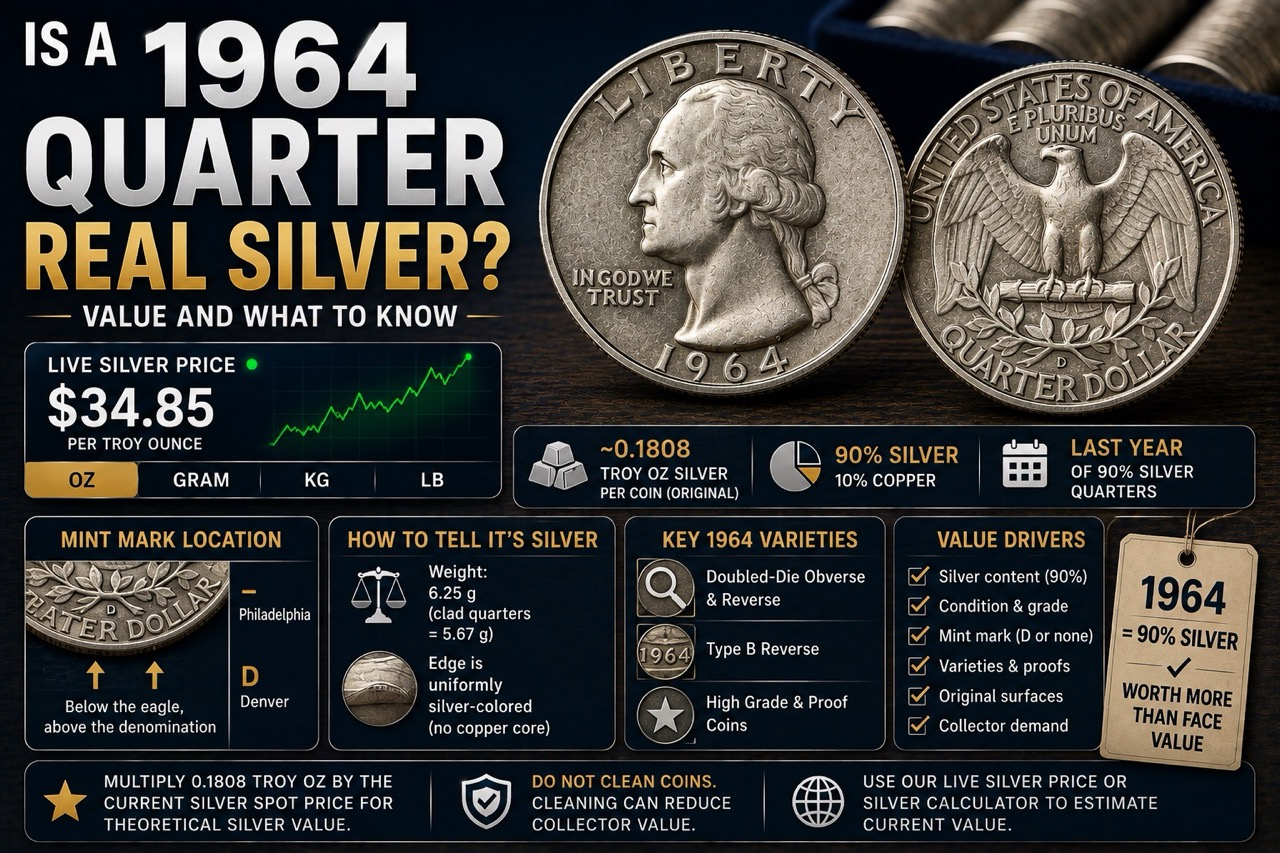
Yes. A standard 1964 quarter is real silver, containing 90% silver and 10% copper with approximately 0.1808 troy oz of actual silver at original specifications. Its silver content alone makes it worth more than face value at modern silver prices, while high-grade coins and recognized varieties can carry additional collector premiums.
The 1964 quarter also marks the end of an era. It was the final date of the traditional 90% silver Washington quarters. The Coinage Act of 1965 removed silver from regular circulating quarters and replaced the old composition with copper-nickel clad coinage.
Use the live price below to calculate your quarter’s current silver value.
[LIVE_PRICE_EMBED]
Silver Content of a 1964 Quarter
A standard 1964 Washington quarter contains approximately 0.1808 troy oz of pure silver.
Its original specifications are 6.25 grams total weight, 90% silver and 10% copper. PCGS identifies the 1932–1964 Washington quarter type as silver and lists the 1964 issue at 90% silver.
The calculation is:
6.25 g × 0.90 = 5.625 g silver
Then:
5.625 ÷ 31.1035 ≈ 0.1808 troy oz silver
| Specification | 1964 Washington Quarter |
|---|---|
| Face value | $0.25 |
| Standard weight | 6.25 g |
| Composition | 90% silver, 10% copper |
| Pure silver weight | 5.625 g |
| Silver content | ~0.1808 troy oz |
| Diameter | 24.3 mm |
A circulated coin can weigh slightly less because wear removes small amounts of metal. The 0.1808-troy-ounce figure represents the original silver content.
Current Melt Value of a 1964 Quarter
Multiply the current silver spot price per troy ounce by 0.1808 to estimate the theoretical silver value of a 1964 quarter.
Use:
0.1808 × current silver spot price = theoretical silver value
Check our live silver price for the current spot price.
This calculation measures only the contained silver. It does not guarantee what a dealer, bullion buyer, or collector will pay.
A dealer’s buy price may differ from theoretical melt value, while a collectible coin can sell above its silver value because of grade, variety, or condition.
Is a 1964 Quarter Worth More Than Melt Value?
Most worn 1964 quarters derive much of their value from silver, but collectible examples can command premiums above their metal content.
Philadelphia and Denver produced very large numbers of quarters dated 1964:
| Mint | Mint Mark | Mintage |
|---|---|---|
| Philadelphia | None | 560,390,585 |
| Denver | D | 704,135,528 |
PCGS confirms both mintage figures.
With more than 1.26 billion regular quarters struck between the two mints, an ordinary circulated 1964 quarter is not rare simply because of its date.
Condition can change its collector value. An uncirculated coin with original luster and few marks may command a larger premium than a heavily worn example.
Recognized varieties can also matter. PCGS catalogs 1964 doubled-die obverse and reverse varieties as well as the Type B Reverse.
Where Is the Mint Mark on a 1964 Quarter?
Look on the reverse below the eagle and above the denomination to find the mint mark on a 1964 Washington quarter.
There are two standard possibilities:
- No mint mark: Philadelphia
- D: Denver
A 1964-D quarter contains the same 90% silver composition as the Philadelphia issue. The D identifies where the coin was struck, not a different silver purity.
If the mint mark is difficult to see, use good lighting and magnification. Do not polish the coin to reveal it.
Why Was 1964 the Last Year for Silver Quarters?
The Coinage Act of 1965 ended the use of silver in regular circulating U.S. quarters.
Silver supplies and coin shortages had become major concerns by the mid-1960s. President Lyndon Johnson signed the Coinage Act on July 23, 1965, removing silver from circulating dimes and quarters and authorizing clad coinage.
The Philadelphia Mint began producing the new clad quarters on August 23, 1965. These coins used copper-nickel faces bonded to a pure copper core.
For Washington quarters from this transition period, the distinction is straightforward:
1932–1964 Washington quarters: 90% silver
Regular 1965 and later circulation quarters: copper-nickel clad
Later collector issues were also struck in silver, so a post-1964 date does not mean that every quarter ever produced with that date range is necessarily clad.
How Can You Tell If a 1964 Quarter Is Silver?
If a 1964 Washington quarter is genuine and has the normal specifications, it should be 90% silver.
The edge provides a useful visual check. A modern clad quarter normally shows a copper-colored layer along its edge, while a 90% silver quarter has a more uniformly silver-colored edge.
Weight provides another clue. A 1964 silver quarter has a standard weight of 6.25 grams, compared with 5.67 grams for the later copper-nickel-clad Washington quarter.
Wear, scale accuracy, and counterfeit coins can complicate weight testing. Do not scratch, file, or acid-test a potentially collectible quarter.
If its specifications seem wrong, have the coin authenticated instead.
What Makes a 1964 Quarter More Valuable?
Grade, original surfaces, and recognized varieties can make a 1964 silver quarter worth more than its metal value.
Check for:
- Uncirculated condition
- Strong original mint luster
- Minimal contact marks
- Recognized doubled-die varieties
- Type B Reverse
- Proof characteristics
- Attractive original toning
- Lack of cleaning or damage
PCGS catalogs multiple doubled-die reverse varieties for Philadelphia 1964 quarters, along with a doubled-die obverse and Type B Reverse.
An uncirculated, or Mint State, coin shows no wear from circulation. It can still have contact marks caused during production and handling.
Avoid cleaning the coin. Polishing changes the original surface and can reduce collector appeal.
Frequently Asked Questions
How much silver is in a 1964 quarter?
A standard 1964 Washington quarter contains approximately 0.1808 troy oz of silver.
That equals 5.625 grams of pure silver at its original 6.25-gram weight.
What is a 1964 silver quarter worth?
The 1964 silver quarter value starts with its contained silver:
0.1808 × current silver spot price
High-grade coins, proofs, and recognized varieties can carry additional collector value.
Is a 1964-D quarter made of silver?
Yes. A standard 1964-D quarter contains 90% silver and 10% copper, just like the Philadelphia issue.
The Denver Mint produced 704,135,528 quarters bearing the 1964 date.
Are all 1964 Washington quarters 90% silver?
Standard genuine U.S. Washington quarters dated 1964 were struck in the traditional 90% silver, 10% coppercomposition.
If a supposed 1964 quarter has an unusual weight, edge, design, or composition, check its authenticity before assigning a value.
The Bottom Line
A genuine 1964 quarter contains 90% silver, equal to approximately 0.1808 troy oz of actual silver at original specifications. Its theoretical metal value is therefore 0.1808 times the current silver spot price.
1964 was the final date of the traditional 90% silver Washington-quarter series before the shift to clad circulating quarters. High-grade coins and recognized varieties can be worth more than their silver content, so avoid cleaning an unusually well-preserved example.
Use our live silver price or silver calculator to estimate its current silver value.