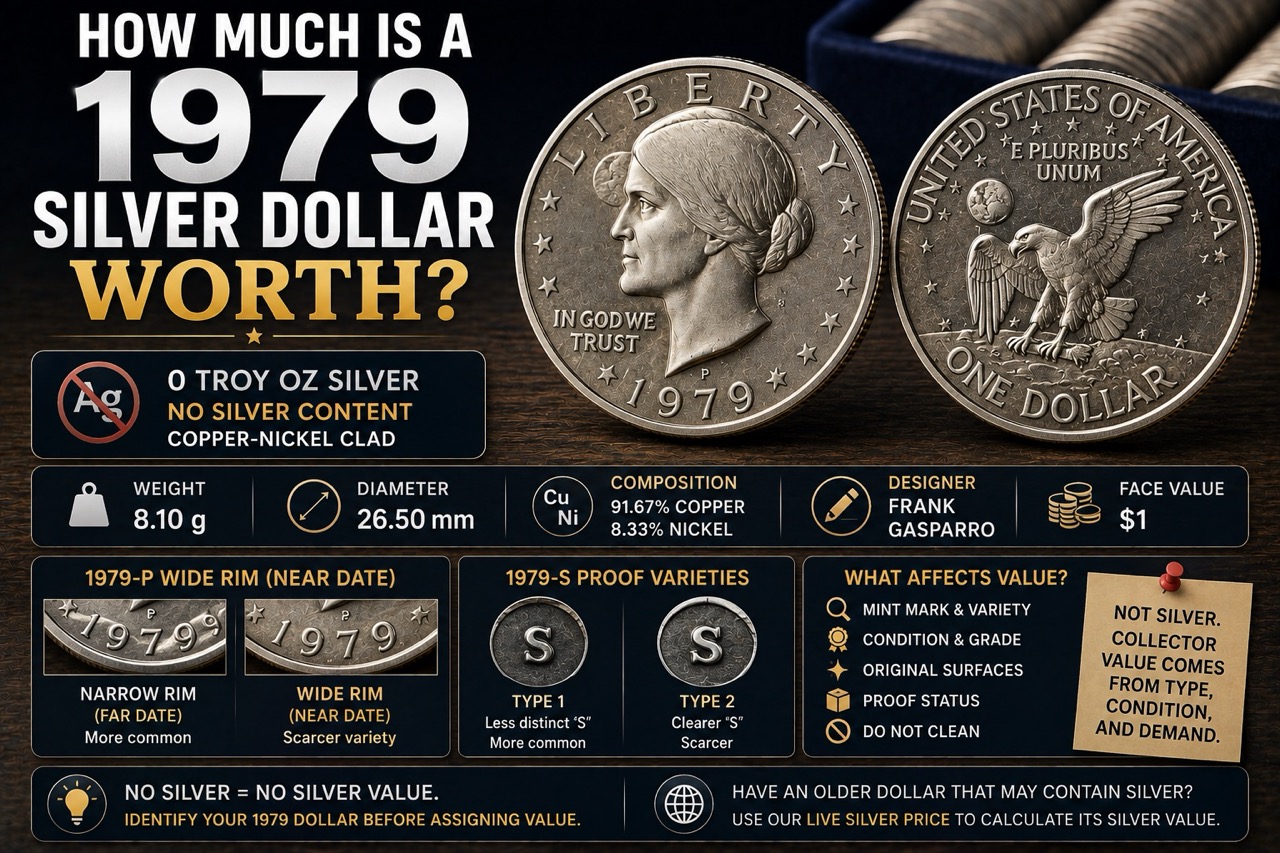
A 1979 Susan B. Anthony dollar contains no silver, so it has no silver melt value. Despite its silver-gray appearance, the coin is copper-nickel clad. Most ordinary examples derive their value from the $1 denomination and collector demand rather than precious-metal content.
Some 1979 dollars deserve closer inspection. The 1979-P Wide Rim, also called the Near Date, is a scarcer Philadelphia variety, while 1979-S proofs have two recognized mint-mark types. High-grade examples can also command collector premiums.
The key is identifying exactly which 1979 dollar you have.
Silver Content of a 1979 Dollar
A 1979 Susan B. Anthony dollar contains 0 troy oz of silver.
The U.S. Mint lists the coin as cupro-nickel clad, with an overall composition of 8.33% nickel and the balance copper.
Its outer layers consist of 75% copper and 25% nickel bonded to a pure copper center. PCGS lists a standard weight of 8.10 grams and diameter of 26.50 mm.
| Specification | 1979 Susan B. Anthony Dollar |
|---|---|
| Face value | $1 |
| Standard weight | 8.10 g |
| Diameter | 26.50 mm |
| Overall composition | 91.67% copper, 8.33% nickel |
| Silver content | 0 troy oz |
| Designer | Frank Gasparro |
The silver-gray color comes from the copper-nickel outer layers. It does not indicate silver content.
Current Melt Value of a 1979 Silver Dollar
There is no silver melt value to calculate because a standard 1979 Susan B. Anthony dollar contains no silver.
For silver content:
0 troy oz × current silver spot price = $0 in contained silver
That does not mean the coin itself is worthless. It retains its $1 face value, and collectible examples can be worth more.
For this reason, this article does not use the live silver-price widget. Silver spot prices have no direct role in valuing a standard 1979 Susan B. Anthony dollar.
Is a 1979 Dollar Worth More Than Face Value?
Some 1979 Susan B. Anthony dollars can be worth more than $1 because of variety, proof status, or condition.
The series began in 1979 and became the first U.S. circulating coin to depict a real woman. Frank Gasparro designed the coin, and its reverse adapted the Apollo 11 imagery previously used on the Eisenhower dollar.
For 1979 coins, check the mint mark and then inspect for recognized varieties.
The Philadelphia Mint also introduced the P mint mark on Anthony dollars. PCGS notes that this was the first use of P on the dollar denomination.
Condition matters as well. An ordinary circulated coin and a superb uncirculated example can have very different collector values even though both contain the same amount of silver: none.
What Is the 1979-P Wide Rim Dollar?
The 1979-P Wide Rim, or Near Date, is one of the key varieties to check for on a 1979 Susan B. Anthony dollar.
There are two major rim styles on 1979-P business strikes:
- Narrow Rim/Far Date: more space appears between the date and rim.
- Wide Rim/Near Date: the rim is wider and the date sits much closer to it.
PCGS identifies the Wide Rim as the scarcer variety.
The difference resulted from an obverse design modification made during 1979. PCGS reports that the vast majority of Philadelphia coins use the Narrow Rim design.
The 1979-P Wide Rim dollar still contains no silver. Its premium comes from relative scarcity and collector demand.
What About the 1979-S Proof Dollar?
The 1979-S Susan B. Anthony proof has two recognized mint-mark varieties: Type 1 and Type 2.
The difference is in the appearance of the S.
On Type 1 proofs, the mint mark has a less distinct, filled appearance. Type 2 uses a clearer S. PCGS reports that Type 2 was produced later in 1979 and represents the smaller share of the year’s proof production.
Neither type contains silver.
Proof coins have specially prepared surfaces intended for collectors, so avoid touching the faces or attempting to polish them. Fingerprints and cleaning can permanently alter the surfaces.
What Makes a 1979 Susan B. Anthony Dollar Valuable?
Variety, grade, proof status, and surface preservation matter more than metal content because the coin contains no silver.
Check for:
- P, D, or S mint mark
- 1979-P Wide Rim/Near Date
- 1979-S Type 1 or Type 2 proof
- Uncirculated condition
- High numerical grade
- Original surfaces
- Scratches or other damage
- Evidence of cleaning
Do not clean the coin. Polishing cannot reveal hidden silver, and altered surfaces can reduce collector appeal.
If you think you have a Wide Rim or unusual proof, compare it with authenticated examples before assigning a value.
Frequently Asked Questions
Is a 1979 Susan B. Anthony dollar made of silver?
No. A 1979 Susan B. Anthony dollar is copper-nickel clad and contains no silver. The U.S. Mint lists the composition as 8.33% nickel with the balance copper.
How much silver is in a 1979 dollar coin?
A standard 1979 Susan B. Anthony dollar contains 0 troy oz of silver.
Its silver-gray appearance comes from its copper-nickel outer layers.
What is a 1979-P Wide Rim dollar?
The 1979-P Wide Rim dollar, also called the Near Date, has a wider obverse rim that places the date noticeably closer to the rim. It is scarcer than the normal Narrow Rim/Far Date variety.
Is a 1979-S Susan B. Anthony dollar silver?
No. The 1979-S Susan B. Anthony dollar contains no silver.
Collectors do recognize Type 1 and Type 2 proof varieties based on the appearance of the S mint mark.
The Bottom Line
If you’re checking how much is a 1979 silver dollar worth, the first fact to know is that a 1979 Susan B. Anthony dollar contains no silver. Silver spot prices therefore do not determine its value.
Check 1979-P coins for the scarcer Wide Rim/Near Date variety and 1979-S proofs for Type 1 or Type 2 mint marks. Condition can also add collector value.
If you have an older dollar that may contain precious metal, use our live silver price to calculate its silver value.