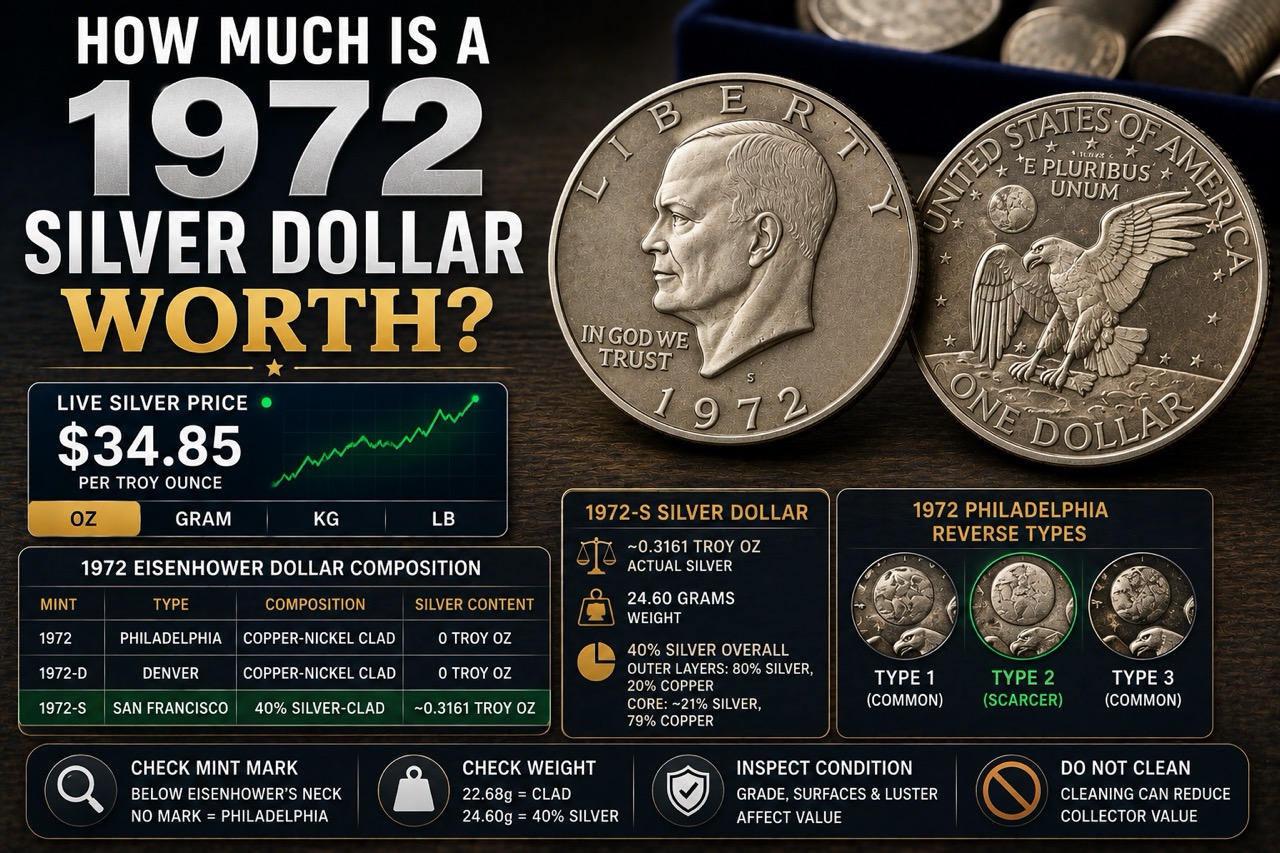
Most 1972 Eisenhower dollars contain no silver, but 1972-S collector coins contain 40% silver and approximately 0.3161 troy oz of actual silver. Regular 1972 Philadelphia and 1972-D Eisenhower dollars are copper-nickel clad, so silver spot prices do not determine their metal value.
There is another reason to inspect a 1972 dollar carefully. Philadelphia coins have three recognized reverse types, including the scarcer Type 2, which can carry a collector premium despite containing no silver.
Identify the mint and issue before calculating value.
[LIVE_PRICE_EMBED]
Silver Content of a 1972 Silver Dollar
Regular 1972 and 1972-D Eisenhower dollars contain no silver, while 1972-S collector issues contain 40% silver overall.
The basic differences are:
| 1972 Eisenhower Dollar | Mint | Composition | Silver Content |
|---|---|---|---|
| 1972 | Philadelphia | Copper-nickel clad | 0 troy oz |
| 1972-D | Denver | Copper-nickel clad | 0 troy oz |
| 1972-S | San Francisco | 40% silver-clad | ~0.3161 troy oz |
The silver 1972-S weighs 24.60 grams. Its outer layers consist of 80% silver and 20% copper, while its core is approximately 21% silver and 79% copper.
Combined, that construction produces a coin that is about 40% silver by total weight.
PCGS records both uncirculated and proof 1972-S silver issues, with mintages of 2,193,056 and 1,811,631 respectively.
Current Melt Value of a 1972-S Silver Dollar
Only the 1972-S silver-clad Eisenhower dollar has a silver melt value.
It contains approximately:
0.3161 troy oz of silver
Use this formula:
0.3161 × current silver spot price = theoretical silver melt value
Check our live silver price for the current spot price.
Do not use this calculation for a regular 1972 or 1972-D Eisenhower dollar. Those issues contain no silver.
Melt value is also different from market value. Grade, proof status, variety, original surfaces, packaging, and collector demand can push the selling price above the value of the contained silver.
Is a 1972 Eisenhower Dollar Worth More Than Melt?
Yes. A 1972 Eisenhower dollar can have collector value even when it contains no silver.
The most important example for beginners is the Philadelphia 1972 Type 2 reverse.
Philadelphia Eisenhower dollars from this year are divided into Type 1, Type 2, and Type 3 reverses based primarily on differences in the depiction of Earth above the eagle.
The Type 2 is the scarcer and more desirable of the three major reverse types.
This coin still contains no silver. Its additional value comes from its numismatic scarcity and collector demand.
That distinction matters: a clad Type 2 can potentially be worth more than an ordinary 40% silver 1972-S.
How Can You Tell If a 1972 Eisenhower Dollar Is Silver?
For a 1972 Eisenhower dollar, start by checking the mint mark below Eisenhower’s neck on the obverse.
For this date:
- No mint mark: Philadelphia, copper-nickel clad
- D: Denver, copper-nickel clad
- S: San Francisco, 40% silver collector issue
Weight can provide another check. The standard clad Eisenhower dollar weighs 22.68 grams, while the 40% silver-clad version weighs about 24.60 grams.
This identification rule applies to 1972 issues specifically. Do not assume every S-mint Eisenhower dollar from every year has the same composition.
Avoid destructive testing. Do not file the edge, scratch the surface, or use acid on a potentially collectible coin.
What Is the 1972 Type 2 Eisenhower Dollar?
The 1972 Type 2 is a scarcer Philadelphia reverse variety identified by the design of Earth above the eagle.
It has no mint mark and contains no silver.
Collectors distinguish the three Philadelphia reverse types by details of the Earth design, including the appearance and positioning of land features.
The Type 2 is the one most owners should check carefully before assuming a no-mint-mark 1972 dollar has little collector value.
Use authenticated comparison images or a recognized numismatic reference for attribution. Wear, lighting, weak strikes, and damage can make the reverse details difficult to interpret.
If you believe you have a Type 2 in high grade, professional authentication may be appropriate.
What Makes a 1972 Eisenhower Dollar More Valuable?
Composition, variety, grade, proof status, and surface preservation can all affect the 1972 Eisenhower dollar value.
Check:
- Mint mark
- Clad or 40% silver composition
- Type 1, Type 2, or Type 3 reverse on Philadelphia coins
- Circulated or uncirculated condition
- Proof status
- Original mint luster
- Contact marks
- Cleaning or polishing
- Other damage
- Original collector packaging
The 1972-S provides a good example of why exact identification matters. PCGS recognizes both regular-strike and proof silver versions.
Do not clean the coin. Polishing can permanently alter its original surfaces and reduce collector appeal.
Frequently Asked Questions
Is a 1972 Eisenhower dollar made of silver?
Most are not. Regular 1972 Philadelphia and 1972-D Eisenhower dollars contain no silver.
The 1972-S collector issues contain 40% silver overall and approximately 0.3161 troy oz of actual silver.
How much is a 1972-S silver dollar worth?
A 1972-S silver dollar contains approximately 0.3161 troy oz of silver.
Calculate its theoretical silver value with:
0.3161 × current silver spot price
Its collector value can be higher depending on grade, proof status, surfaces, and demand.
Is the 1972 Type 2 Eisenhower dollar silver?
No. The 1972 Type 2 Eisenhower dollar is a Philadelphia copper-nickel-clad coin.
Its collector premium comes from the scarcer reverse variety rather than precious-metal content.
How much silver is in a 1972 silver dollar?
Regular 1972 and 1972-D Eisenhower dollars contain 0 troy oz of silver.
A 1972-S silver-clad collector coin contains approximately 0.3161 troy oz of actual silver.
The Bottom Line
If you’re checking how much is a 1972 silver dollar worth, identify both the mint and the issue before calculating silver value. Regular 1972 and 1972-D Eisenhower dollars contain no silver, while 1972-S collector coins contain approximately 0.3161 troy oz.
A no-mint-mark Philadelphia coin also deserves inspection for the scarcer Type 2 reverse. Its potential premium comes from collector demand rather than silver content.
For a 1972-S silver issue, use our live silver price to calculate its current theoretical silver value.