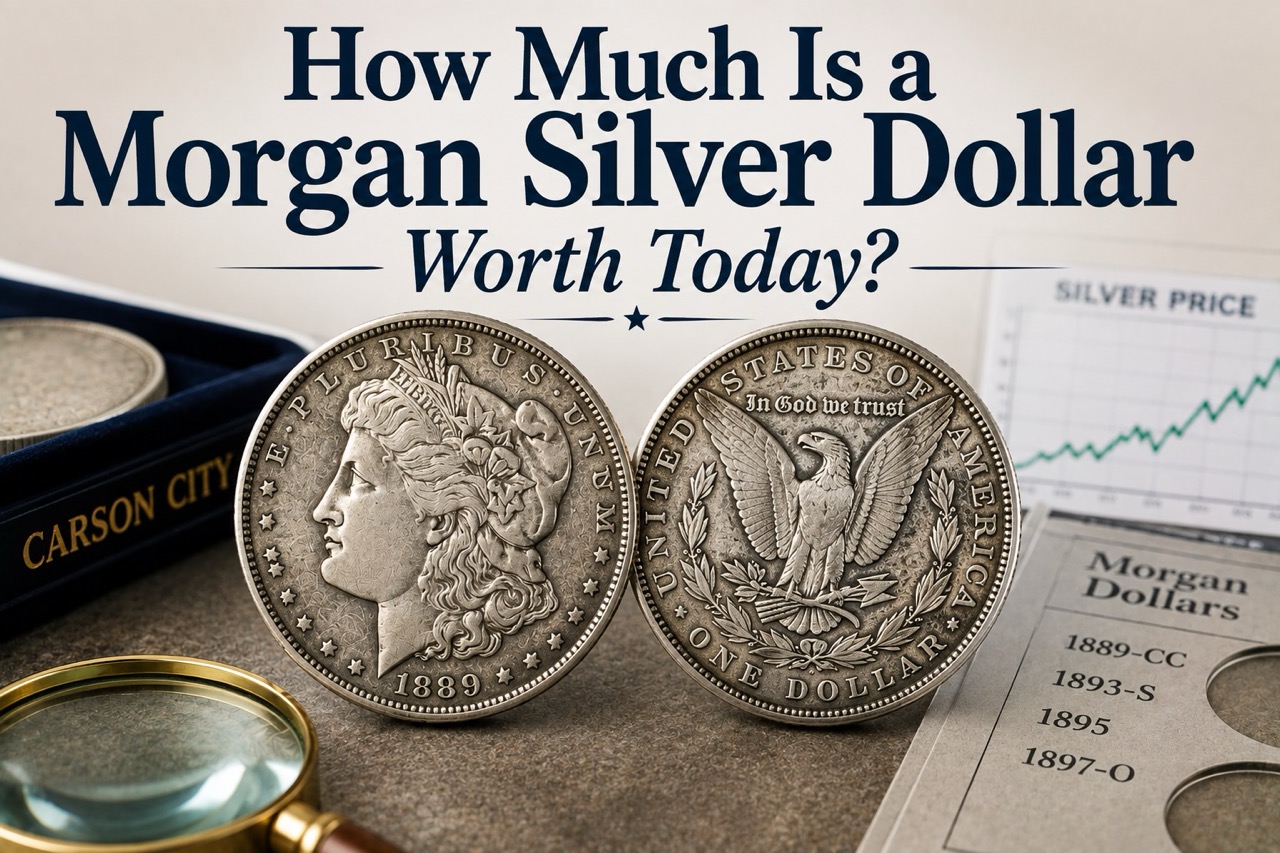
A Morgan silver dollar contains 0.7734 troy oz of silver at original specifications, but its collector value can be much higher than its silver value. The U.S. Mint confirms that Morgan dollars were struck at a standard weight of 26.73 grams in an alloy of 90% silver and 10% copper.
The exact answer to how much is a Morgan silver dollar worth depends on the current silver price, date, mint mark, condition, and variety. Common circulated coins may derive much of their value from silver, while key dates such as the 1889-CC and 1893-S occupy a much higher collector-value tier.
[LIVE_PRICE_EMBED]
Morgan Dollar Value: Melt Value vs. Collector Value
A Morgan dollar has 0.7734 troy oz of silver at original specifications, but melt value is only the starting point for determining what the coin is worth.
Calculate theoretical silver value with:
0.7734 × current silver spot price
That figure represents the value of the contained silver based on the coin’s original specifications.
Collector value is separate.
| Value Factor | Why It Matters |
|---|---|
| Silver content | Every standard Morgan originally contained about 0.7734 troy oz |
| Date | Some years had much scarcer issues |
| Mint mark | The same date can vary greatly by mint |
| Grade | High-grade examples can be far scarcer |
| Variety | Some die varieties carry collector premiums |
| Surface condition | Cleaning or damage can hurt desirability |
| Eye appeal | Luster, toning, strike, and marks affect demand |
A common circulated Morgan and a rare 1893-S contain essentially the same amount of silver at original specifications. Their collector values can be dramatically different because the 1893-S is a recognized key issue.
Morgan Silver Dollar Value by Year
The year is your first clue, but always check the mint mark before estimating Morgan silver dollar value.
Morgan dollars were produced from 1878 through 1904 and again in 1921. Philadelphia, Carson City, New Orleans, San Francisco, and Denver struck coins in the series.
| Year | Collector Significance | What to Check |
|---|---|---|
| 1878 | First year; multiple major varieties | Mint and tail-feather variety |
| 1879 | Some scarcer mint combinations | Especially CC |
| 1880 | Many obtainable examples | Mint and condition |
| 1881 | Many available examples | CC and high-grade coins |
| 1882 | Generally obtainable | CC and condition |
| 1883 | Generally obtainable | CC and condition |
| 1884 | 1884-S is scarce in high grade | Mint mark and grade |
| 1885 | Many obtainable examples | Mint and grade |
| 1886 | Many obtainable examples | Mint and grade |
| 1887 | Many obtainable examples | Mint and varieties |
| 1888 | Several collectible varieties | Mint and variety |
| 1889 | 1889-CC is a key date | Check for CC |
| 1890 | Generally obtainable | Mint and grade |
| 1891 | Grade becomes increasingly important | Mint and condition |
| 1892 | Several challenging issues | Especially S in high grade |
| 1893 | Major key-date year | Especially 1893-S |
| 1894 | Several desirable issues | Mint and grade |
| 1895 | Major rarity year | Philadelphia is Proof-only |
| 1896 | Many obtainable examples | Mint and grade |
| 1897 | Generally obtainable | Mint and grade |
| 1898 | Generally obtainable | Mint and grade |
| 1899 | Some scarcer combinations | Mint and condition |
| 1900 | Generally obtainable | Mint and varieties |
| 1901 | Some issues become difficult in high grade | Mint and grade |
| 1902 | Generally obtainable | Mint and grade |
| 1903 | 1903-S deserves attention | Mint mark |
| 1904 | Last year before the long production gap | Especially 1904-S |
| 1921 | Large-production final year | P, D, S, grade, and variety |
PCGS identifies 1889-CC, 1893-S, and the Proof-only 1895 as Morgan dollar key issues. It also identifies coins such as the 1895-O as condition rarities, meaning they may be obtainable in lower grades but become extremely scarce in high grade.
This table should be used to decide which coins deserve closer research. It is not a substitute for a date-and-mint-specific price guide.
What Are the Main Morgan Dollar Key Dates?
The 1889-CC, 1893-S, and 1895 Philadelphia Proof are three of the most important Morgan dollar key dates.PCGS specifically identifies all three as keys to the series.
1889-CC Morgan Dollar
The 1889-CC is one of the major Carson City keys.
The CC mint mark identifies a coin struck at the Carson City Mint. Not every Carson City Morgan is equally scarce, so you should never value a coin simply because it carries CC.
The 1889-CC is an exception that deserves immediate attention because its numismatic premium can far exceed its silver value.
1893-S Morgan Dollar
The 1893-S is another principal key to the series.
If you have an 1893 Morgan, check the reverse for an S mint mark. PCGS identifies the 1893-S as a key issue rather than merely a high-grade condition rarity.
Because rare Morgan dollars can attract counterfeits and altered mint marks, a potentially valuable example should be authenticated before a major transaction.
1895 Morgan Dollar
The Philadelphia 1895 Morgan dollar is Proof-only in the recognized series. PCGS lists the issue among the principal Morgan keys and estimates only hundreds of Proof examples surviving across all grades.
The 1895-O is a different coin. It was struck for circulation at New Orleans and is particularly difficult in Mint State. PCGS estimates far more survivors in all grades than in Mint State, which makes it a classic condition rarity.
What Is a Morgan Dollar Condition Rarity?
A condition rarity is a coin that may be obtainable in worn grades but becomes exceptionally scarce in high grade.
The 1884-S provides a strong example.
PCGS estimates roughly 199,980 surviving 1884-S Morgans across all grades but only about 1,980 in MS60 or better and five in MS65 or better.
The 1895-O follows the same general pattern. PCGS estimates tens of thousands of survivors overall but only hundreds in MS60 or better.
This explains why checking only the date and mintage can mislead you.
A worn coin and an uncirculated coin of the same date and mint can occupy completely different value tiers.
How Much Is a Morgan Dollar Worth in Silver?
The Morgan dollar melt value equals 0.7734 multiplied by the current silver spot price.
The U.S. Mint gives the original Morgan standard as:
26.73 grams total weight
90% silver
10% copper
The calculation is:
26.73 × 0.90 = 24.057 grams of silver
Then convert grams to troy ounces:
24.057 ÷ 31.1035 ≈ 0.7734 troy oz
So:
Morgan dollar theoretical silver value = 0.7734 × silver spot price
Use the live calculator above rather than a fixed dollar figure because silver prices change continuously.
A heavily circulated Morgan may weigh slightly less than its original 26.73 grams because wear removes metal. The 0.7734 figure therefore describes original silver content rather than a guarantee that every circulated coin still contains exactly that amount.
How Much More Than Melt Can a Morgan Dollar Be Worth?
The numismatic premium ranges from relatively modest for many common circulated coins to extremely large for key dates and high-grade condition rarities.
The important distinction is that silver content stays essentially the same at original specifications while rarity does not.
An 1884-S illustrates how grade alone can transform scarcity. PCGS estimates nearly 200,000 survivors overall but only five at MS65 or better.
The 1895-O shows a similar pattern. It survives in meaningful numbers in lower grades but is very rare in Mint State.
For this reason, avoid using a simple formula such as:
melt value + fixed percentage = Morgan value
No single percentage works across the series.
Instead, calculate the silver value first, then identify the date, mint, grade, and variety.
Where Is the Mint Mark on a Morgan Dollar?
The Morgan dollar mint mark appears on the reverse beneath the ribbon bow of the wreath.
PCGS confirms that non-Philadelphia Morgan mint marks appear in this location.
Look for:
- CC — Carson City
- O — New Orleans
- S — San Francisco
- D — Denver
- No mint mark — Philadelphia
Denver only produced Morgan dollars in 1921.
Checking the mint mark can change your valuation completely. An 1889 Philadelphia Morgan and an 1889-CC contain the same standard amount of silver, but the 1889-CC is a recognized key date.
How Does Condition Affect Morgan Dollar Value?
Condition can multiply the value of a Morgan dollar, especially for dates that are scarce in Mint State.
Professional grading services use the 70-point Sheldon grading scale. Circulated coins fall below Mint State, while uncirculated business-strike coins receive grades beginning at MS60.
For a quick first inspection, look at:
- Wear on Liberty’s hair and cheek
- Wear on the eagle’s breast feathers
- Mint luster
- Contact or bag marks
- Scratches
- Cleaning or polishing
- Strike quality
- Toning and overall eye appeal
Morgan dollars also receive special designations for reflective fields, including Prooflike and Deep Mirror Prooflike coins.
Do not assume a shiny Morgan is uncirculated. Polishing can create an artificial shine while damaging the original surface.
Should You Clean a Morgan Dollar?
No. Do not clean a Morgan dollar before identifying and valuing it.
Cleaning can remove original surface material, create hairline scratches, or produce an unnatural appearance.
That can reduce collector demand even though the coin looks brighter afterward.
Natural dark or multicolored toning is not automatically a defect. Some collectors prefer original surfaces, including naturally toned coins.
If you think the coin may be a key date or high-grade example, leave the surface unchanged until a knowledgeable dealer or grading service evaluates it.
Should You Get a Morgan Dollar Professionally Graded?
Professional grading makes the most sense when authentication or grade could materially affect the coin’s value.
Consider professional grading for:
- 1889-CC
- 1893-S
- 1895 issues
- Other scarce date-and-mint combinations
- High-grade-looking coins
- Prooflike examples
- Potentially valuable varieties
- Coins with questionable authenticity
For a worn, common-date Morgan, grading fees and shipping costs may represent too much of the coin’s market value.
Identify the date and mint first. Then compare the likely value across several grades before paying for certification.
Frequently Asked Questions
How much is a common Morgan silver dollar worth?
A common Morgan dollar’s value depends on silver spot price, date, mint, condition, and current collector demand.
Start by calculating its theoretical silver value:
0.7734 × current silver spot price
Then determine whether the coin carries an additional numismatic premium.
What is the Morgan dollar melt value?
The Morgan dollar melt value is based on 0.7734 troy oz of silver at original specifications.
Multiply 0.7734 by today’s silver spot price to estimate contained-metal value.
What are the main Morgan dollar key dates?
PCGS identifies the 1889-CC, 1893-S, and 1895 Proof as key Morgan dollar issues.
Other coins can be scarce by date, mint, variety, or grade, so this list should not be treated as the only valuable Morgans.
Is a 1921 Morgan dollar valuable?
Most 1921 Morgans are much more available than the major key dates, but value still depends on mint, condition, variety, and current demand.
A high-grade or desirable variety can command a stronger premium than an ordinary circulated example.
Where is the mint mark on a Morgan silver dollar?
Look on the reverse beneath the ribbon bow of the wreath. PCGS confirms that Morgan dollars struck outside Philadelphia carry their mint marks there.
Philadelphia Morgans normally have no mint mark.
The Bottom Line
If you’re asking how much is a Morgan silver dollar worth, start with 0.7734 troy oz of silver at original specifications. That establishes the coin’s theoretical contained-silver value, but it does not tell you the full collector value.
Check the year, mint mark, condition, and variety before selling. The 1889-CC, 1893-S, and Proof-only 1895 are recognized key issues, while coins such as the 1884-S and 1895-O can become especially scarce in high grades.
Use our live silver price to calculate the metal value, then research the exact date and mint before accepting a bullion-based offer.