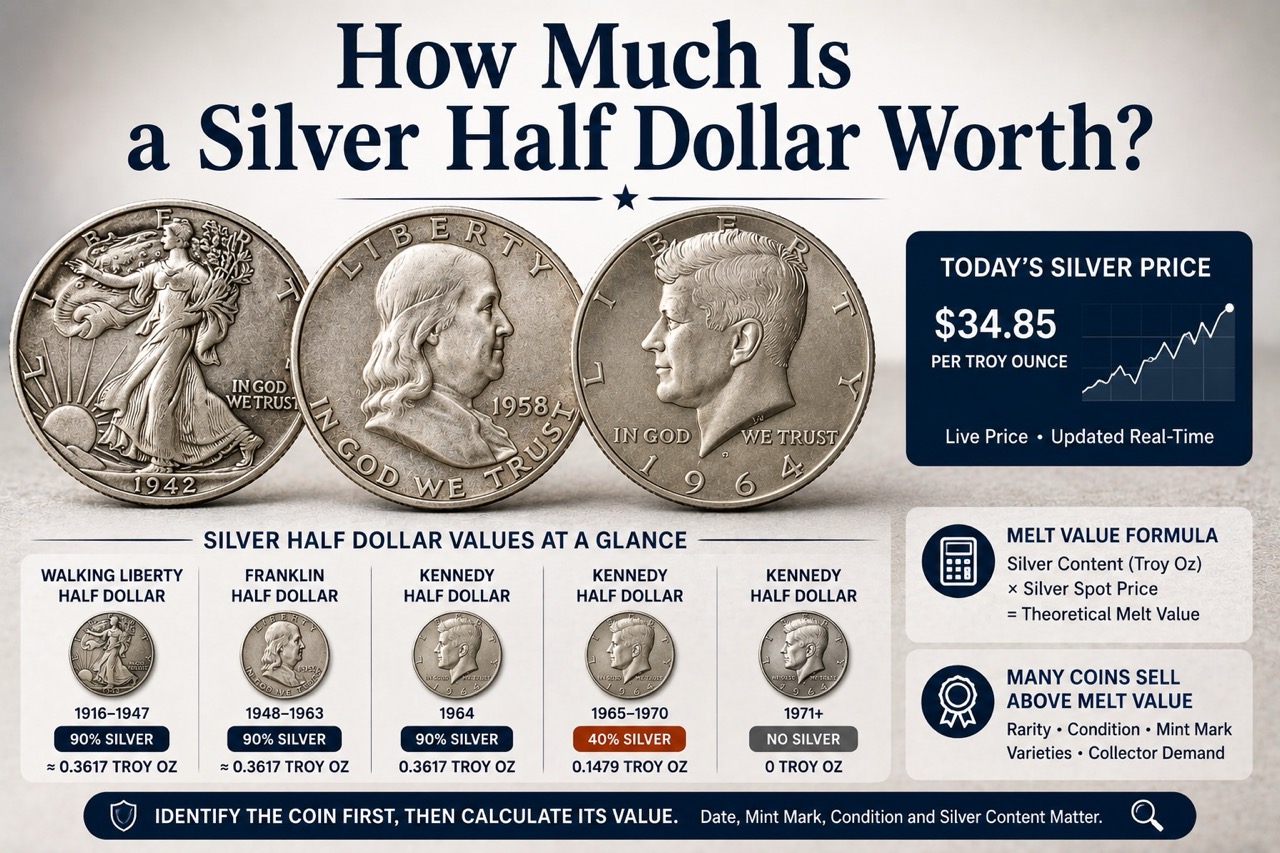
A silver half dollar is worth at least the market value represented by its contained silver, but many examples sell for more because of collector demand. A 1964 Kennedy half dollar contains 0.3617 troy oz of silver and is 90% silver, while Kennedy halves dated 1965–1970 contain 0.1479 troy oz and are 40% silver.
Earlier Walking Liberty and Franklin half dollars are also 90% silver. Regular Kennedy half dollars made for circulation switched to copper-nickel clad construction in 1971.
So, how much is a silver half dollar worth depends first on the coin type and silver content, then on date, mint mark, condition, variety, and collector demand.
[LIVE_PRICE_EMBED]
Silver Half Dollar Values at a Glance
For melt value, multiply the coin’s silver content by the current silver spot price.
| Half Dollar Type | Dates | Silver Purity | Silver Content |
|---|---|---|---|
| Walking Liberty Half Dollar | 1916–1947 | 90% | ~0.3617 troy oz |
| Franklin Half Dollar | 1948–1963 | 90% | ~0.3617 troy oz |
| Kennedy Half Dollar | 1964 | 90% | 0.3617 troy oz |
| Kennedy Half Dollar | 1965–1970 | 40% | 0.1479 troy oz |
| Kennedy Half Dollar — regular circulation issues | 1971+ | 0% | 0 troy oz |
The U.S. Mint identifies the Walking Liberty series as 1916–1947, the Franklin series as 1948–1963, and notes that silver was removed from the regular half-dollar composition in 1971.
For Kennedy halves, the key dates are:
1964 = 90% silver
1965–1970 = 40% silver
1971+ regular circulation issues = no silver
Later collector products require separate identification because some were struck in silver.
How Much Is a 1964 Kennedy Half Dollar Worth?
A 1964 Kennedy half contains 0.3617 troy oz of silver, so its theoretical melt value equals 0.3617 multiplied by the current silver spot price.
The coin was struck in the traditional:
90% silver composition
The U.S. Mint later described the 1965 half dollar as containing 40% silver compared with the previous 90% silver Kennedy halves.
Use this formula:
0.3617 × silver spot price = theoretical contained-silver value
That is not necessarily the coin’s full market value.
Uncirculated examples, proofs, varieties, and high-grade coins can sell above melt because collectors value the coin itself in addition to its silver.
Do not polish or clean a 1964 half before selling or grading it. Altering the original surface can reduce numismatic value.
How Much Is a 1965–1970 Kennedy Half Dollar Worth?
Kennedy half dollars dated 1965 through 1970 contain 0.1479 troy oz of silver and use a 40% overall silver composition.
The U.S. Mint announced the change in 1965, explaining that the new half dollar would contain 40% silver rather than the previous 90%.
The theoretical melt-value formula is:
0.1479 × silver spot price
Compare the silver content:
1964 Kennedy: 0.3617 troy oz
1965–1970 Kennedy: 0.1479 troy oz
A 1964 half therefore contains well over twice as much silver as a 1965–1970 half.
Do not group all pre-1971 Kennedy halves together as 90% silver. Only the 1964-dated regular issue uses the 90% composition.
Are Franklin Half Dollars Silver?
Yes. Franklin half dollars from 1948 through 1963 are 90% silver and contain approximately 0.3617 troy oz of silver at original specifications.
The U.S. Mint identifies the Franklin half-dollar series as running from 1948 through 1963.
Their theoretical melt value is:
0.3617 × silver spot price
Franklin halves can also carry collector premiums.
Value can depend on:
- Date
- Mint mark
- Condition
- Strike quality
- Full Bell Lines designation
- Collector demand
A common circulated Franklin may trade largely on its bullion value plus a market premium. A high-grade or desirable example can be worth substantially more.
Are Walking Liberty Half Dollars Silver?
Yes. Walking Liberty half dollars from 1916 through 1947 are 90% silver and contain approximately 0.3617 troy oz of silver at original specifications.
The U.S. Mint confirms the Walking Liberty half-dollar series ran from 1916 through 1947.
Its theoretical silver value is:
0.3617 × current silver spot price
Walking Liberty halves often have stronger collector interest than common later silver halves because of their age, design, and date-and-mint combinations.
Some dates and mint marks command substantial numismatic premiums.
Before selling one strictly for its silver, identify the date and mint mark.
How Do You Calculate a Silver Half Dollar’s Melt Value?
Multiply the coin’s silver content in troy ounces by the current silver spot price.
For a 90% silver half:
0.3617 × silver spot price
For a 40% Kennedy half:
0.1479 × silver spot price
For multiple coins, calculate the total silver first.
Ten 90% halves contain, at original specifications:
10 × 0.3617 = 3.617 troy oz silver
Ten 40% Kennedy halves contain:
10 × 0.1479 = 1.479 troy oz silver
Then multiply the total troy ounces by the current spot price.
The live calculator near the top of this page can handle the current-price portion.
Remember that the result is theoretical contained-metal value, not a guaranteed dealer offer. Actual buying and selling prices can include premiums, spreads, and numismatic value.
Is a Silver Half Dollar Worth More Than Melt Value?
Many silver half dollars sell above their theoretical melt value because collectors also value the coin’s date, condition, and rarity.
Important factors include:
- Date
- Mint mark
- Grade
- Rarity
- Variety
- Strike quality
- Original surface condition
- Collector demand
This matters most with older Walking Liberty halves and better-date Franklin or Kennedy coins.
Even a common silver half may trade above melt because buyers often pay a premium for recognizable U.S. silver coinage.
The amount of silver gives you a useful reference value, but it is not a complete appraisal.
Check the exact coin before agreeing to a bullion-only price.
Are Half Dollars After 1970 Silver?
Regular Kennedy half dollars produced for circulation from 1971 onward are copper-nickel clad, but some later collector issues contain silver.
The U.S. Mint resumed circulation production in 1971 using copper-nickel clad material after legislation eliminated the 40% silver content.
That makes this a useful rule for ordinary circulated coins:
1971+ circulation Kennedy = no silver
But do not apply that rule to every collector issue.
For example, the U.S. Mint produced a 2014 Kennedy Half-Dollar Silver Coin Collection containing four coins struck in 90% silver.
If a later Kennedy half came from a proof set, anniversary product, or other collector packaging, identify the exact issue before deciding its composition.
How Can You Tell If a Half Dollar Is Silver?
Start with the date and series.
For Kennedy halves:
- 1964: 90% silver
- 1965–1970: 40% silver
- 1971+: clad for ordinary circulation, with some later silver collector exceptions
Franklin and Walking Liberty halves are 90% silver.
The edge can provide another clue. A normal copper-nickel clad half often shows a copper-colored layer along the edge, while a silver half has a more uniformly silver-gray appearance.
Do not treat edge color as proof. Toning, wear, lighting, and collector compositions can complicate visual identification.
For a valuable or unusual coin, verify the exact issue rather than using appearance alone.
How Much Is $10 Face Value of Silver Half Dollars Worth?
Twenty half dollars equal $10 face value, but their silver content depends on whether they are 90% or 40% coins.
Twenty 90% halves contain at original specifications:
20 × 0.3617 = 7.234 troy oz silver
Twenty 40% Kennedy halves contain:
20 × 0.1479 = 2.958 troy oz silver
Then multiply the relevant total by the current silver spot price.
For circulated 90% coins, actual remaining metal can be slightly lower because wear removes small amounts of material over time.
This is why you should separate 1964 Kennedy halves from 1965–1970 halves before valuing a mixed group.
Frequently Asked Questions
How much is a 1964 half dollar worth?
Its theoretical silver value equals:
0.3617 × current silver spot price
Its market value may be higher based on condition, variety, proof status, and collector demand.
What is the Kennedy half dollar silver value?
A 1964 Kennedy half contains 0.3617 troy oz of silver.
Kennedy halves dated 1965–1970 contain 0.1479 troy oz.
What is a 40% silver half dollar worth?
A 40% Kennedy half’s theoretical contained-silver value is:
0.1479 × current silver spot price
Regular Kennedy halves from 1965 through 1970 use this 40% silver composition.
Are all 1964 half dollars silver?
Regular U.S. Kennedy half dollars dated 1964 were struck in 90% silver.
At original specifications, each contains 0.3617 troy oz of silver.
Are 1971 half dollars silver?
Regular 1971 Kennedy half dollars are copper-nickel clad and contain no silver. The U.S. Mint began producing the new clad half dollars in February 1971.
Later collector Kennedy halves can use silver compositions, so special issues should be identified individually.
The Bottom Line
If you’re asking how much is a silver half dollar worth, start with the date and series. A 1964 Kennedy, Franklin, or Walking Liberty half contains approximately 0.3617 troy oz of silver at original specifications, while a 1965–1970 Kennedy half contains 0.1479 troy oz.
Multiply that silver content by the current spot price to estimate theoretical melt value. Then check the date, mint mark, condition, and variety because collector value can push the market price higher.
Use our live silver price with the calculator above before comparing offers.