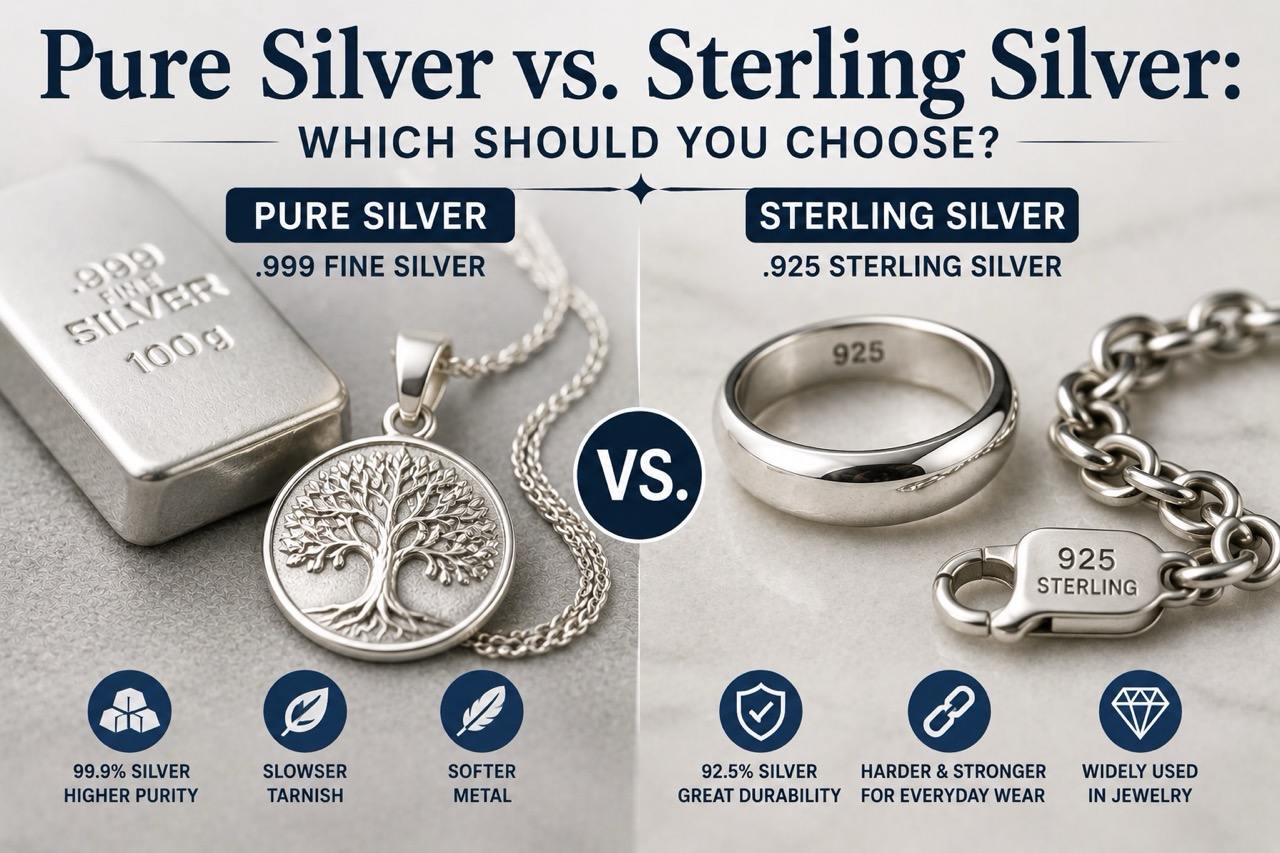
In the pure silver vs sterling silver comparison, sterling is usually the better choice for everyday jewelry because it is harder, while pure or fine silver offers higher silver content. Fine silver is commonly .999, meaning 99.9% silver, while sterling contains 92.5% silver and is commonly marked 925.
The remaining 7.5% in sterling consists of other metals, with copper commonly used. Those alloying metals make sterling more resistant to bending and deformation than fine silver.
Both are genuine silver. The better choice depends on whether you care more about durability, purity, silver content, or intended use.
Pure Silver vs. Sterling Silver at a Glance
Fine silver wins on purity, while sterling silver generally wins on practicality for everyday jewelry.
| Feature | Fine Silver | Sterling Silver |
|---|---|---|
| Typical fineness | .999 | .925 |
| Silver content | 99.9% | 92.5% |
| Other material | About 0.1% | 7.5% |
| Relative hardness | Softer | Harder |
| Common marks | 999, .999, FINE SILVER | 925, .925, STERLING |
| Tarnishes? | Yes | Yes |
| Tarnish rate | Generally slower | Generally faster |
| Precious metal? | Yes | Yes |
| Silver value per gram | Higher | Lower |
| Typical jewelry use | Specialty and artisan pieces | Rings, chains, bracelets, earrings |
| Bullion use | Common | Less common |
“Pure silver” is often used casually to mean fine silver, usually .999 fineness. That is not the same as saying the metal is chemically perfect 100% silver.
What Is Pure Silver?
Pure silver usually means fine silver with a fineness of .999, or approximately 99.9% silver.
A 999 mark represents:
999 parts silver per 1,000
That high purity leaves very little alloying material.
The tradeoff is softness. Fine silver can scratch, dent, and bend more readily than sterling in comparable designs.
That makes it less practical for some high-wear jewelry components, including thin rings, clasps, and delicate chain links.
Fine silver still works well in many applications, including:
- Bullion bars
- Bullion rounds
- Pendants
- Earrings
- Artisan jewelry
- Heavier or carefully designed pieces
Its higher purity is especially useful where silver content matters more than resistance to deformation.
What Is Sterling Silver?
Sterling silver is an alloy containing 92.5% silver and 7.5% other metals.
FTC consumer guidance confirms that the words silver, sterling, and sterling silver describe products containing 92.5% pure silver. It also explains that 925 means 925 parts per thousand are silver. (consumer.ftc.gov)
Its basic composition is:
92.5% silver + 7.5% other metals
Copper commonly makes up much of the remaining portion.
Common sterling marks include:
925
.925
STERLING
S925
Sterling contains less silver than .999 fine silver, but its increased hardness makes it more practical for many types of jewelry.
For more detail, see what 925 sterling silver is.
999 Silver vs. 925 Silver: What’s the Difference?
The main difference between 999 silver vs 925 silver is fineness: .999 contains 99.9% silver, while .925 contains 92.5%.
For a 100-gram piece:
.999 silver: 100 × 0.999 = 99.9 grams silver
.925 sterling: 100 × 0.925 = 92.5 grams silver
The difference is:
99.9 − 92.5 = 7.4 grams silver per 100 grams of metal
That means fine silver has greater theoretical silver value at equal total weight.
[LIVE_PRICE_EMBED]
The basic formulas are:
Fine silver: weight in grams × 0.999 ÷ 31.1035 × silver spot price
Sterling: weight in grams × 0.925 ÷ 31.1035 × silver spot price
These are theoretical contained-metal values, not guaranteed resale offers. Dealer spreads, refining costs, product premiums, condition, and collector demand can all affect what someone will actually pay.
Which Is Better for Jewelry?
Sterling silver is generally better for everyday jewelry because it is harder than fine silver.
That added hardness matters for pieces that experience repeated contact and stress, including:
- Rings
- Clasps
- Bracelets
- Chain links
- Prong settings
Fine silver is softer and can deform more easily in comparable designs.
That does not make fine silver a poor jewelry material. Construction matters.
A thick fine-silver pendant can easily be more durable than a thin sterling ring. Work-hardening and manufacturing technique can also change how a finished piece behaves.
For most everyday jewelry, though, sterling offers a more practical balance between high silver content and usable hardness.
Does Pure Silver Tarnish?
Yes. Fine silver can tarnish because silver itself reacts with sulfur-containing gases.
CCI identifies silver sulfide as the tarnish compound that forms on pure silver.
Fine silver therefore is not tarnish-proof.
Sterling generally tarnishes faster under comparable conditions. CCI specifically notes that sterling’s copper content increases its tarnishing rate because copper is more reactive than silver.
Sterling tarnish can also contain copper sulfide in addition to silver sulfide.
Storage affects both metals. Limiting exposure to sulfur-containing gases and high humidity can slow tarnish formation. CCI recommends dry storage because silver tarnishes faster as relative humidity rises in the presence of hydrogen sulfide.
Is Sterling Silver Pure Silver?
No. Sterling is genuine silver, but it is not fine silver.
Sterling contains:
92.5% silver
Fine silver contains approximately:
99.9% silver
Calling 925 sterling “pure silver” can therefore create confusion.
That does not mean sterling is fake or plated. Its silver runs throughout the alloy, unlike silver plate, where silver exists as a surface layer over another material.
FTC guidance explicitly distinguishes sterling silver from silver plate. (consumer.ftc.gov)
If you are trying to identify an unknown object, use our sterling silver hallmarks guide to interpret its markings.
Which Is Worth More?
At equal weight, .999 fine silver has higher intrinsic silver value because it contains more silver.
A gram of .999 fine silver contains approximately:
0.999 g silver
A gram of sterling contains:
0.925 g silver
That difference matters for bullion, scrap, and melt-value calculations.
Finished jewelry can tell a different story.
A branded or antique sterling piece may sell for much more than an equal-weight fine-silver object because value can also depend on:
- Maker
- Craftsmanship
- Design
- Gemstones
- Age
- Condition
- Rarity
- Collector demand
For current metal-value comparisons, check the live silver price.
Which Should You Choose?
Choose sterling for most everyday jewelry and fine silver when higher silver purity matters more than hardness.
Sterling makes more sense if you want:
- Rings and bracelets for regular wear
- Durable clasps or chains
- A broad jewelry selection
- The familiar 925 standard
Fine silver makes more sense if you want:
- Higher silver purity
- More silver content per gram
- Bullion
- A specific artisan piece made from .999 silver
Neither is universally better.
The decision is really a tradeoff between purity and mechanical practicality.
Frequently Asked Questions
Is fine silver better than sterling silver?
Fine silver vs sterling silver depends on the use.
Fine silver has greater purity. Sterling is generally harder and better suited to jewelry that receives frequent wear.
Is sterling silver pure silver?
No. Sterling contains 92.5% silver and 7.5% other metals.
It is genuine silver alloy, but it is not .999 fine silver.
What is the difference between 999 silver and 925 silver?
.999 means approximately 99.9% silver, while .925 means 92.5% silver.
At equal weight, .999 silver contains more silver, while .925 sterling generally has greater hardness.
Does pure silver tarnish?
Yes. Pure or fine silver can form silver sulfide tarnish when exposed to sulfur-containing gases.
Sterling generally tarnishes faster under similar conditions because it contains copper.
The Bottom Line
In the pure silver vs sterling silver comparison, fine silver gives you greater purity while sterling gives up some silver content for better hardness. Fine silver is usually .999, while sterling is .925.
For most everyday jewelry, sterling is the more practical choice. For bullion or situations where maximum silver content matters, fine silver makes more sense.
If you are comparing marks on an existing object, use our sterling silver hallmarks guide to understand 925, 999, and other common silver stamps.