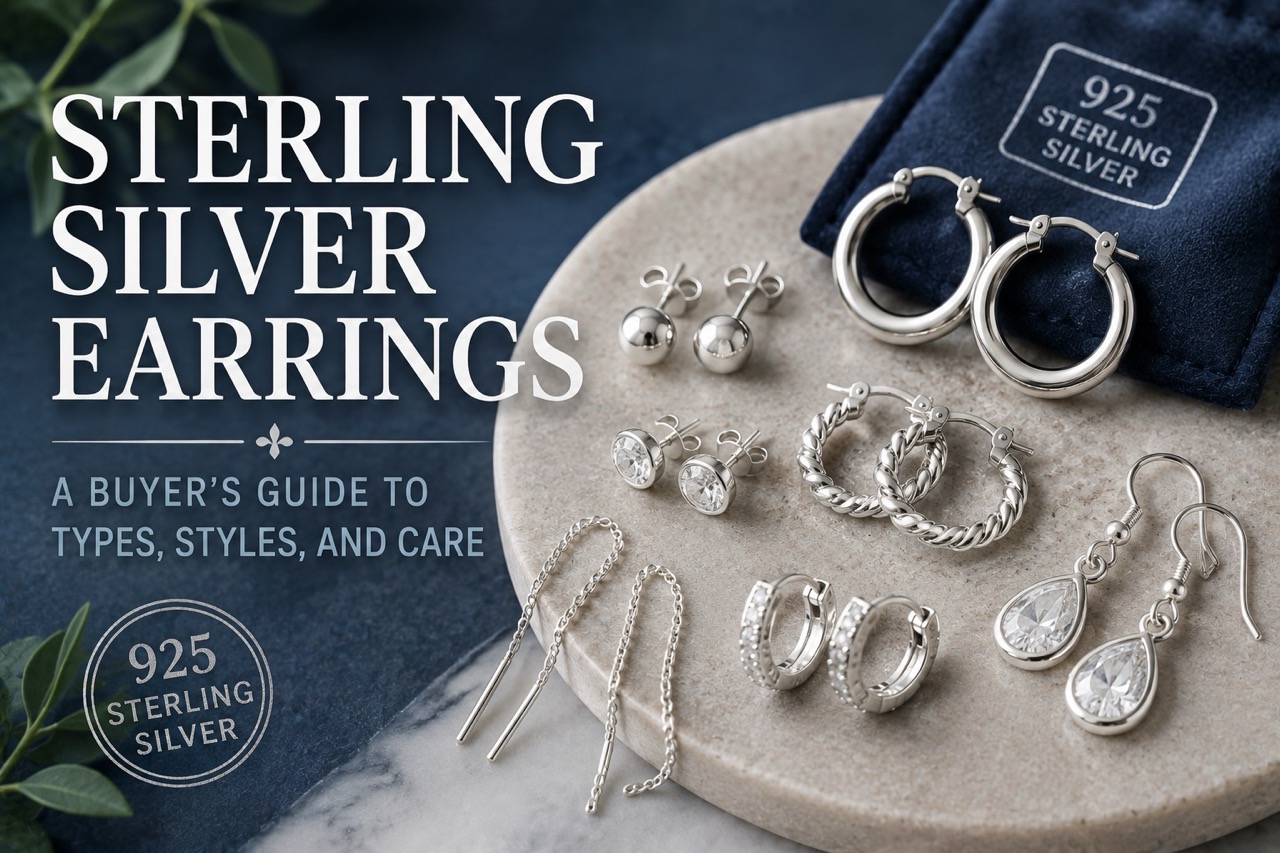
Sterling silver earrings contain at least 92.5% silver, with the remaining portion made from alloying metals. The alloy gives you high silver content in a form better suited to everyday jewelry than softer fine silver.
Before buying, check more than the design. Look at the metal description, 925 marking, dimensions, weight, closure, and materials used for posts, hooks, and backs.
Your best choice depends on how you plan to wear the earrings. Studs work well for a compact everyday look, while hoops, drops, and dangles offer more size and movement.
What Does 925 Mean on Sterling Silver Earrings?
A 925 mark represents silver that is 925 parts per thousand, or 92.5%, pure silver.
FTC jewelry guidance states that products described as “sterling silver” or “sterling” must be at least 925/1000 silver.
Common marks include:
925.925STERLINGSTER
On small earrings, the mark may appear on a post, hook, back, or another small component. You may need magnification to read it.
A stamp should not be your only authenticity check. Consider the product description, seller, construction, and any maker identification alongside the fineness mark.
FTC consumer guidance also distinguishes sterling from silver plate, which has a layer of silver over another material.
Use our silver hallmarks guide if you find a mark you do not recognize.
Which Type of Sterling Silver Earrings Should You Buy?
Choose the style based on size, movement, comfort, and how often you expect to wear the earrings.
| Type | Design | Best For |
|---|---|---|
| Studs | Sit against the earlobe | Everyday, minimal look |
| Hoops | Circular or partial-circle design | Everyday to statement wear |
| Huggies | Small hoops close to the lobe | Compact everyday wear |
| Drops | Hang below the earlobe | Added length |
| Dangles | Freely moving hanging designs | More movement |
| Threaders | Chain or wire passes through piercing | Lightweight elongated look |
| Ear cuffs | Wrap around the ear | Styling with or without a piercing, depending on design |
Product photographs can make earrings appear larger than they are. Check millimeter measurements before ordering.
Sterling Silver Stud Earrings
Sterling silver stud earrings are a practical choice when you want a small design that sits close to the ear.
A typical stud consists of a decorative front, straight post, and separate backing. Check the diameter of the decorative portion before buying.
For example, a 4 mm stud creates a much smaller look than a 10 mm stud even when both appear similarly sized in enlarged retailer photos.
Also check the post and backing materials. Do not assume that every component uses the same alloy simply because the decorative portion is described as sterling.
Sterling Silver Hoop Earrings
Sterling silver hoop earrings vary considerably in both diameter and thickness.
Diameter determines the overall size of the hoop. Thickness controls how substantial it appears from the front and side.
A large hollow hoop can weigh less than a smaller solid hoop, so size alone does not tell you how heavy the earrings will feel.
Common closures include hinged mechanisms, latch backs, endless designs, and straight posts with separate backs. Check both dimensions and closure type before choosing.
Drop and Dangle Earrings
Drop and dangle earrings put more emphasis on length, movement, and weight.
Check the total length in inches or millimeters rather than estimating it from photographs.
Weight also becomes more important with longer designs. Two pairs with similar dimensions can feel very different if one uses solid metal and the other uses lightweight construction.
Are Sterling Silver Earrings Good for Sensitive Ears?
Sterling silver can be suitable for many wearers, but 925 alone does not guarantee that a pair will work for someone with a metal allergy.
Nickel is a common cause of allergic contact dermatitis. The American Academy of Dermatology identifies jewelry, including earrings and earring backs, as common sources of nickel exposure.
If nickel causes problems for you, look for specific material disclosures covering:
- Earring post
- Hook or ear wire
- Earring back
- Decorative body
- Soldered components
A 925 mark tells you the silver fineness of the marked sterling component. It does not necessarily provide a complete ingredient list for every part of the earring.
AAD recommends nickel-free jewelry for people with nickel allergy and includes pure sterling silver among its suggested jewelry materials.
Treat terms such as “hypoallergenic” as product claims rather than guarantees that no wearer will react.
How Can You Tell If Sterling Silver Earrings Are Real?
Start with the fineness mark and product description, then consider the seller and testing if authenticity remains uncertain.
FTC consumer guidance states that sterling silver contains 92.5% pure silver and notes that these products are sometimes marked 925.
Do not confuse these terms:
| Description | Meaning |
|---|---|
| Sterling silver / 925 | At least 92.5% silver |
| Fine silver / 999 | Approximately 99.9% silver |
| Silver plated | Silver coating over another material |
| Silver-tone | Describes appearance, not silver content |
| German silver | Copper-based alloy containing no actual silver |
| Nickel silver | Copper-zinc-nickel alloy containing no actual silver |
A magnet offers only a limited screening test. Strong attraction is inconsistent with a piece being made entirely from sterling silver, but no attraction does not prove that the item is genuine.
For expensive jewelry or questionable pieces, professional precious-metal testing provides better evidence.
Read our 925 sterling silver guide for more identification methods.
Which Earring Closure Is Best?
The best closure balances comfort, convenience, and security for the earring’s size and design.
Butterfly backs use friction to hold a stud post in place. They are common, compact, and easy to replace.
Screw backs attach to threaded posts. They take longer to put on and remove but are designed to resist accidental removal.
Hinged hoops open at a hinge and close around the ear. Check that the mechanism closes cleanly without excessive movement.
Latch backs use a post that connects to a hinged or locking section and commonly appear on hoops and drops.
Fish hooks are curved wires used for many drop and dangle earrings. Some designs add a small stopper behind the ear.
No closure eliminates the possibility of loss. Check frequently worn earrings for bent posts, loose hinges, and worn components.
Sterling Silver vs. Silver-Plated Earrings
Sterling silver and silver-plated earrings can look similar when new, but their construction is fundamentally different.
Sterling contains at least 92.5% silver throughout the sterling component. Silver-plated jewelry has a surface coating of silver over another material. The FTC treats these as separate product descriptions.
| Feature | Sterling Silver | Silver Plated |
|---|---|---|
| Silver content | At least 92.5% in sterling component | Silver surface layer |
| Base metal underneath | No unrelated base-metal core in solid sterling component | Yes |
| Surface wear | Sterling remains underneath | Base metal may eventually become exposed |
| Common marking | 925, sterling | Should be described as plated |
If a retailer uses confusing wording such as “925 silver plated,” read the complete material description before buying.
For pierced earrings, check whether the post and backing use the same material as the main earring.
What Should You Check Before Buying?
A useful listing should tell you the metal, dimensions, weight, and component materials.
Before ordering 925 silver earrings, check:
- Metal: Confirm 925 sterling rather than silver plate or silver-tone.
- Size: Check diameter for studs and hoops and length for drops.
- Weight: Especially useful for large hoops or dangles.
- Post or hook: Check its material separately.
- Backing: Verify the metal if you have sensitivities.
- Closure: Choose one you can use comfortably and securely.
- Hallmark: Look for an appropriate fineness mark.
- Stones: Check whether gemstones are natural, lab-grown, or simulated if that distinction matters to you.
- Quantity: Confirm whether the listing is for a pair or single earring.
- Returns: Check whether pierced earrings can be returned after opening or trying them on.
Exact measurements are more useful than photographs for comparing size.
How Do You Care for Sterling Silver Earrings?
Keep sterling earrings clean and dry, limit exposure to tarnish-causing materials, and avoid unnecessary aggressive polishing.
Silver exposed to sulfur-containing gases can develop a surface layer of tarnish. On silver, this is primarily silver sulfide; sterling tarnish can also contain copper sulfide.
Tarnish may progress through yellow or other colors before becoming dark gray or black. This surface reaction does not mean your earrings are fake.
After wearing plain sterling earrings, wipe them gently with a clean, soft cloth before storage. Keeping silver in a closed container can reduce exposure to tarnishing gases.
Use extra care with pearls, porous gemstones, intentional oxidation, adhesives, and plated details. A cleaning method that works for plain sterling may not be appropriate for every decorative material.
Avoid excessive polishing. Tarnish removal also removes a small amount of underlying silver, so repeated aggressive polishing can gradually alter a piece.
Frequently Asked Questions
Are 925 silver earrings real silver?
Yes. Genuine 925 silver earrings contain at least 92.5% silver in the sterling components.
The FTC recognizes 925/1000 as the minimum fineness for jewelry represented as sterling silver.
Can you wear sterling silver earrings every day?
Many sterling earrings can handle regular wear. Comfort and durability depend on weight, construction, closure, and how you treat them.
Check frequently worn posts, backs, and hinges for damage.
Do sterling silver earrings tarnish?
Yes. Genuine sterling silver can tarnish.
Sulfur-containing gases react with silver and produce surface discoloration that can eventually become dark or black.
Are sterling silver earrings nickel-free?
Not automatically based on a 925 mark alone. If you have a nickel allergy, look for a specific nickel-free disclosure covering the parts that contact your ear.
Nickel exposure from earrings and earring backs is a recognized cause of allergic contact dermatitis.
Are sterling silver earrings better than silver-plated earrings?
Sterling contains far more silver and does not depend on a thin silver coating over a base metal.
Silver-plated earrings can cost less, but the surface layer can wear and expose the underlying material.
The Bottom Line
Good sterling silver earrings start with genuine 92.5% silver, but material is only one part of the buying decision. Check dimensions, weight, closures, post and backing materials, and construction before ordering.
For sensitive ears, look for specific nickel-free material disclosures rather than relying only on 925 or “hypoallergenic” wording. Keep your earrings dry, store them away from tarnish-causing materials, and polish only as needed.
Use our 925 sterling silver guide and silver hallmarks guide to help identify genuine sterling before you buy.