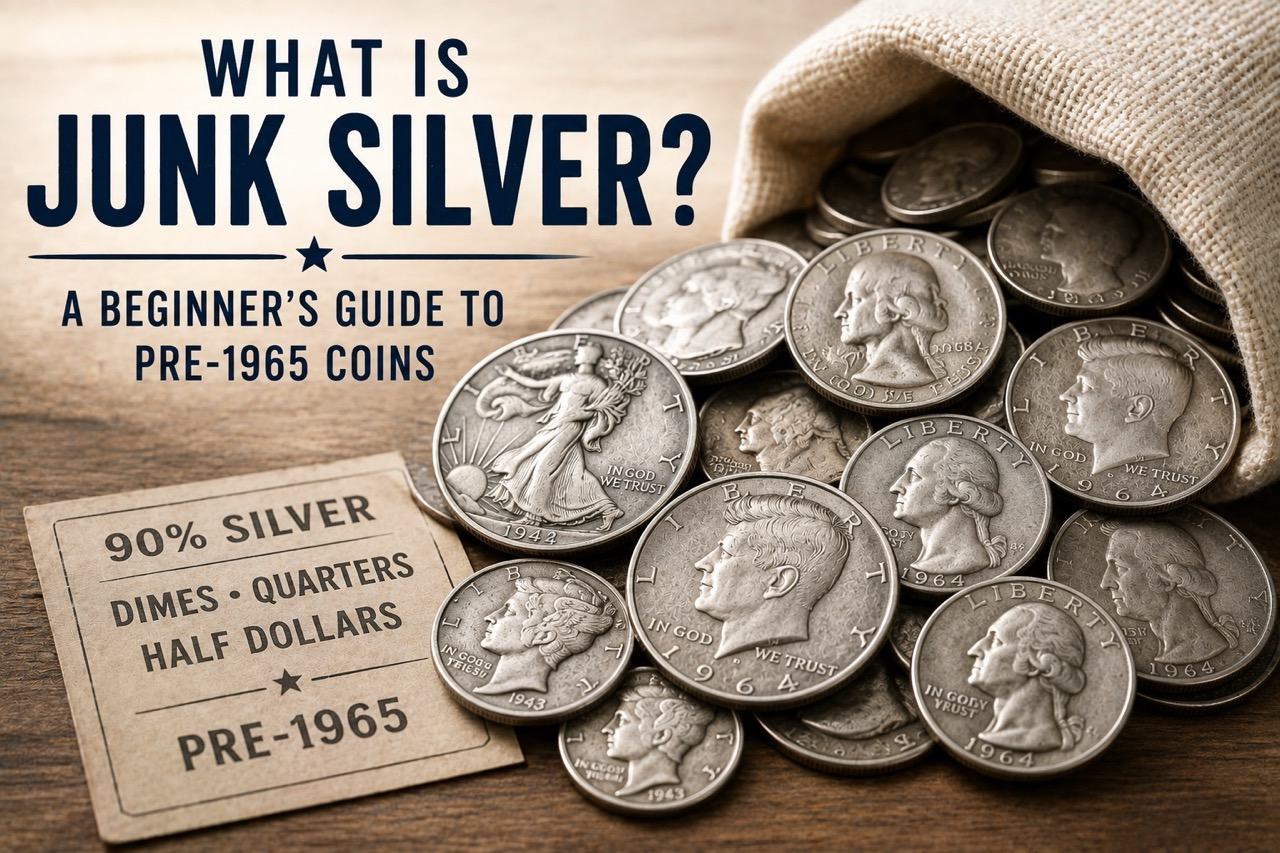
Junk silver is an informal bullion-market term for circulated silver coins valued mainly for their precious-metal content rather than their rarity or condition. In the United States, the term most often refers to common 90% silver dimes, quarters, and half dollars dated 1964 or earlier.
“Junk” does not mean worthless. These are genuine U.S. coins with legal-tender denominations, and their silver content can make them worth many times their face value.
The category can also include some 40% silver coins, particularly Kennedy half dollars dated 1965–1970. Before buying or selling any old silver coin as bullion, check its date, mint mark, and potential collector value.
[LIVE_PRICE_EMBED]
What Coins Count as Junk Silver?
Most U.S. junk silver consists of common circulated 90% silver dimes, quarters, and half dollars from the period before the Coinage Act of 1965 changed circulating coin compositions.
The Act removed silver from circulating dimes and quarters and reduced the half dollar from 90% to 40% silver.
Common examples include:
| Coin | Dates | Silver Purity | Original Silver Content |
|---|---|---|---|
| Mercury dime | 1916–1945 | 90% | ~0.0723 troy oz |
| Roosevelt dime | 1946–1964 | 90% | ~0.0723 troy oz |
| Washington quarter | 1932–1964 | 90% | ~0.1808 troy oz |
| Walking Liberty half | 1916–1947 | 90% | ~0.3617 troy oz |
| Franklin half | 1948–1963 | 90% | ~0.3617 troy oz |
| Kennedy half | 1964 | 90% | 0.3617 troy oz |
| Kennedy half | 1965–1970 | 40% | 0.1479 troy oz |
Older Barber dimes, quarters, and halves can also appear in bulk silver lots. Check them individually because some dates and mint marks have collector value.
Morgan and Peace dollars are also 90% silver, but dealers usually price them separately rather than mixing them into standard bags of fractional 90% silver.
Why Is It Called Junk Silver?
The word “junk” means the coins are being traded primarily for silver content rather than numismatic value.
Numismatic value is the collector value attached to a coin because of its rarity, date, mint, condition, variety, or historical demand.
A worn common-date Washington quarter may trade primarily as silver. A scarce quarter from the same series could be worth much more to a collector.
That is why you should check these details before adding an old coin to a bullion pile:
- Date
- Mint mark
- Series
- Condition
- Major varieties
- Errors or unusual features
Dealer-sorted bags may already have obvious collectible coins removed. Inherited collections, old coin jars, and unsorted accumulations deserve more careful inspection.
How Much Silver Is in Pre-1965 Silver Coins?
Standard U.S. 90% silver dimes, quarters, and half dollars contain silver in proportion to their face values.
At original specifications:
1 dime ≈ 0.0723 troy oz silver
1 quarter ≈ 0.1808 troy oz silver
1 half dollar ≈ 0.3617 troy oz silver
That means:
10 dimes = $1 face
4 quarters = $1 face
2 half dollars = $1 face
Each combination originally contains approximately the same amount of silver:
$1 face ≈ 0.7234 troy oz silver
This relationship makes mixed bags easy to value. A bag can contain dimes, quarters, or halves while still being quoted according to total face value.
Circulation complicates the calculation slightly because wear removes small amounts of metal.
Why Do Dealers Use 0.715 oz Per $1 Face Value?
Dealers commonly use about 0.715 troy oz of silver per $1 face value for average-circulated 90% coins to account for wear.
The original-specification figure is approximately:
$1 face = 0.7234 troy oz
The commonly used circulated convention is:
$1 face ≈ 0.715 troy oz
APMEX, for example, currently specifies 0.715 troy oz of actual silver weight for its average-circulated $1 face-value 90% silver lots.
The difference is small for a few coins but becomes more noticeable with larger bags.
| Face Value | Original Silver Content | 0.715 Circulated Convention |
|---|---|---|
| $1 | ~0.7234 oz | ~0.715 oz |
| $5 | ~3.617 oz | ~3.575 oz |
| $10 | ~7.234 oz | ~7.15 oz |
| $100 | ~72.34 oz | ~71.5 oz |
| $1,000 | ~723.4 oz | ~715 oz |
Check which convention a seller uses before comparing prices.
How Do You Calculate Junk Silver Value?
Multiply the estimated silver content by the current silver spot price to find the theoretical metal value.
For average-circulated 90% silver using the common dealer convention:
face value × 0.715 × silver spot price = estimated metal value
For $10 face:
10 × 0.715 × current spot price
For $100 face:
100 × 0.715 × current spot price
If you are calculating from original coin specifications instead, use approximately 0.7234 troy oz per $1 face.
Neither calculation guarantees the price you will pay or receive.
Physical coins can trade at a premium over their theoretical metal value. A dealer’s buyback offer can also differ from spot because spreads, inventory, demand, and transaction costs affect actual prices.
Use our live silver price before comparing dealer listings.
What Does “20x Face” Mean?
“20x face” means the coins cost 20 times their legal face value.
At 20x:
$1 face = $20
$10 face = $200
$100 face = $2,000
This system makes mixed lots easy to quote.
Suppose a bag contains:
20 dimes = $2 face
12 quarters = $3 face
10 half dollars = $5 face
The total is $10 face value.
At 20x face:
$10 × 20 = $200
Do not judge the price from the multiplier alone.
Convert the lot to its estimated silver content and compare that value with the current spot price.
What Is the Difference Between 90% Silver and Junk Silver?
“90% silver” describes metal composition; “junk silver” describes how common circulated coins are bought and sold.
A 1964 Washington quarter contains 90% silver whether it is heavily worn or in exceptional condition.
A common circulated example might be sold as bullion. A scarce variety or high-grade example might instead be priced individually for collectors.
Not all coins described as junk silver are 90% silver, either.
Kennedy halves dated 1965–1970 contain 40% silver. The U.S. Mint introduced the 40% composition in 1965 and removed silver from regular circulating half dollars beginning in 1971.
Keep 40% coins separate from 90% coins when calculating value.
Junk Silver vs. Silver Bars and Rounds
Junk silver provides fractional legal-tender coins, while bars and rounds generally provide silver in standardized bullion weights.
| Feature | Junk Silver | Bars and Rounds |
|---|---|---|
| Typical purity | 90%; some 40% | Often .999 fine |
| Common units | Dimes, quarters, halves | Troy-ounce weights |
| U.S. legal tender | Yes | Usually no |
| Fractional amounts | Built into denominations | Depends on product |
| Circulation wear | Common | Usually not a major factor |
| Valuation | Often by face value | Usually by stated silver weight |
| Collector premium | Possible | Product-dependent |
Neither format automatically offers a lower premium.
Compare the total purchase price with the actual or stated silver content.
For example:
premium per oz = (purchase price − metal value) ÷ silver ounces
That gives you a more useful comparison than looking only at the total price.
What Should You Check Before Buying Junk Silver?
Check the silver content, face value, condition, and premium before buying a roll or bag.
First, confirm what the listing contains. A $10 face value listing means $10 in coin denominations, not $10 worth of silver.
Next, determine whether the seller uses 0.715 oz per $1 face for average circulated coins or another silver-content assumption.
Also check whether the lot contains only 90% coins. Do not value 40% Kennedy halves at the same rate as 90% dimes, quarters, or 1964 halves.
Condition matters primarily because extreme wear can reduce weight. Watch for exclusions covering bent, holed, damaged, dateless, or heavily worn coins.
Finally, compare premiums between sellers.
This is a natural place to compare current 90% silver coin rolls and bags from bullion retailers such as APMEX and JM Bullion. Compare the effective price per troy ounce of silver rather than assuming one retailer or package size offers the better price.
Are All Pre-1965 Coins Silver?
No. “Pre-1965 silver coins” refers to specific denominations and issues, not every U.S. coin made before 1965.
Pennies and nickels follow different composition histories.
For the common 90% bullion category, focus on qualifying dimes, quarters, and half dollars.
Also avoid reversing the rule and assuming every U.S. quarter made after 1964 contains no silver. Regular 1965 circulation quarters were clad, but later collector products can contain silver.
For example, the Mint produced special Bicentennial quarter, half-dollar, and dollar sets in 40% silver.
Date and denomination are therefore starting points, not substitutes for identifying the exact issue.
Should You Search Junk Silver for Collectible Coins?
Yes. Check unsorted coins before valuing the entire group strictly by silver weight.
Look for:
- Scarce dates
- Better mint marks
- Recognized varieties
- Proof coins
- Unusually high-grade examples
- Errors
This matters especially with older series such as Barber coinage and Walking Liberty half dollars.
Do not clean a coin because it looks dirty or toned.
Cleaning can alter the surface and reduce collector desirability. If one coin looks unusual or substantially better preserved than the rest, set it aside and identify it before including it in a bullion sale.
Frequently Asked Questions
What years are junk silver coins?
For standard U.S. 90% silver dimes and quarters, 1964 and earlier is the basic date rule. Walking Liberty and Franklin halves are 90% silver, as is the 1964 Kennedy half.
Kennedy half dollars dated 1965–1970 contain 40% silver.
How much silver is in $1 face value of junk silver?
At original specifications, $1 face of 90% dimes, quarters, or half dollars contains approximately 0.7234 troy oz of silver.
For average-circulated coins, 0.715 troy oz per $1 face is a common dealer convention.
What is junk silver worth today?
Junk silver value depends on face value, estimated silver content, current spot price, and the market premium.
For average-circulated 90% coins, one common calculation is:
face value × 0.715 × current silver spot price
Use the live price above for the current market figure.
Are pre-1965 silver coins pure silver?
No. Standard U.S. silver dimes, quarters, and half dollars in this category are 90% silver, not pure silver.
The remaining 10% is copper.
Is a 1965 quarter silver?
A regular 1965 U.S. quarter made for circulation is not silver. The Coinage Act of 1965 replaced the previous silver quarter with clad coinage.
Do not extend that rule to every later collector quarter because the U.S. Mint has produced special silver issues.
The Bottom Line
Junk silver is common circulated U.S. silver coinage traded mainly for its metal content rather than collector value. For average-circulated 90% dimes, quarters, and half dollars, about 0.715 troy oz per $1 face value is a widely used bullion-market convention.
Check dates, mint marks, and condition before selling an old coin strictly for silver because some examples have additional numismatic value. Keep 40% Kennedy halves separate from 90% coinage when calculating a lot.
Check our live silver price before comparing dealer premiums or buyback offers.